
Resin in 3D printing.
Resin is a liquid synthetic resin that is cured layer by layer with light in 3D printing. SLA and DLP use it to make parts with a very smooth surface and the finest details, which no other plastic process achieves. In return, resins are less heat-resistant and less impact-resistant than thermoplastics.
- Standard, Transparent, Tough and Ultra Detail
- Details from 0.1 mm (DLP)
- Smooth surface without visible layers
- Painting to Pantone available
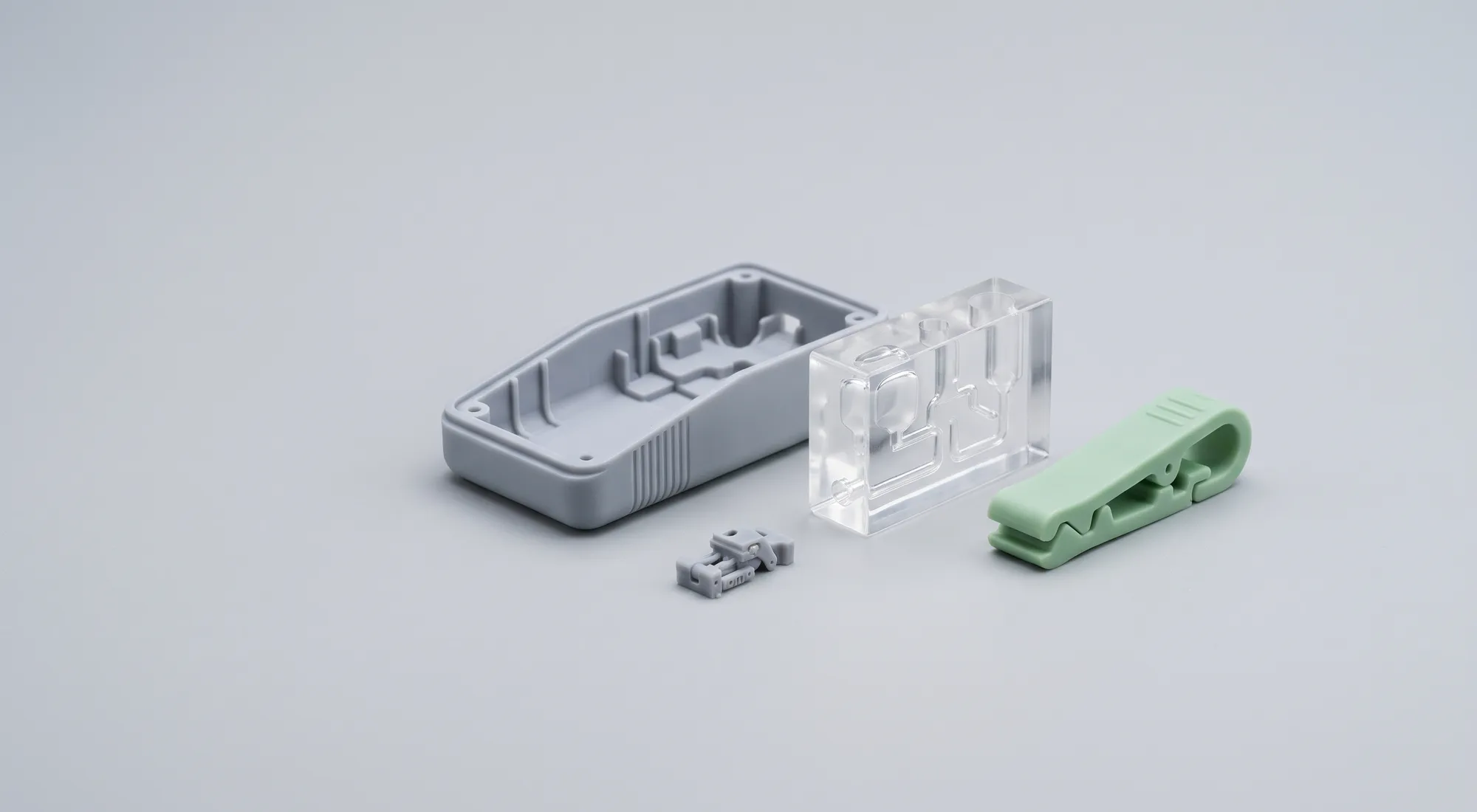






How resin cures in 3D printing.
Resins for 3D printing are photopolymers: mixtures of monomers, oligomers and photoinitiators that cross-link and solidify under UV light. The standard ISO/ASTM 52900 groups these processes as vat photopolymerisation. In stereolithography (SLA) a laser traces the contour of each layer; in DLP a projector exposes the whole layer at once. The part grows upside down or upright out of the resin vat.
After printing the part is not yet finished. It is washed, usually in isopropyl alcohol, to remove liquid resin residue, and then post-cured under UV light. A review in the journal Polymers shows that washing time, temperature and post-curing time noticeably affect the mechanical properties. Finally the support structures are removed and their contact points are sanded.
Because the light can be focused very finely and the layers are thin, the surfaces usually show no print lines. That makes resin the first choice for design and appearance models, fine mechanisms and master patterns for casting.
The resins at Swiss3D compared.
Four resins for different requirements. Mechanical values from the technical data sheets, minimum dimensions from the Material Finder.
| Criterion | Standard Resin | Transparent Resin | Tough Resin | Ultra Detail RC31 (DLP) |
|---|---|---|---|---|
| Strength | Best surface, mechanically similar to ABS | Crystal clear after polishing | Tough and impact-resistant | Highest resolution |
| Tensile strength | – | 50 MPa | 62 MPa | – |
| Elongation at break | – | 10% | 6.8% | – |
| Hardness Shore D | 83 | 87 | 83 | – |
| Smallest detail | 0.4 mm | 0.6 mm | 0.15 mm | 0.1 mm |
| Minimum supported wall | 0.5 mm | 1 mm | 0.6 mm | 0.4 mm |
| Layer thickness | 0.1 mm | 0.1 mm | 0.05 mm | 0.05 mm |
| Largest build volume | On request | 600 × 600 × 450 mm | 145 × 145 × 175 mm | 192 × 120 × 200 mm |
Strength
- Standard Resin
- Best surface, mechanically similar to ABS
- Transparent Resin
- Crystal clear after polishing
- Tough Resin
- Tough and impact-resistant
- Ultra Detail RC31 (DLP)
- Highest resolution
Tensile strength
- Standard Resin
- –
- Transparent Resin
- 50 MPa
- Tough Resin
- 62 MPa
- Ultra Detail RC31 (DLP)
- –
Elongation at break
- Standard Resin
- –
- Transparent Resin
- 10%
- Tough Resin
- 6.8%
- Ultra Detail RC31 (DLP)
- –
Hardness Shore D
- Standard Resin
- 83
- Transparent Resin
- 87
- Tough Resin
- 83
- Ultra Detail RC31 (DLP)
- –
Smallest detail
- Standard Resin
- 0.4 mm
- Transparent Resin
- 0.6 mm
- Tough Resin
- 0.15 mm
- Ultra Detail RC31 (DLP)
- 0.1 mm
Minimum supported wall
- Standard Resin
- 0.5 mm
- Transparent Resin
- 1 mm
- Tough Resin
- 0.6 mm
- Ultra Detail RC31 (DLP)
- 0.4 mm
Layer thickness
- Standard Resin
- 0.1 mm
- Transparent Resin
- 0.1 mm
- Tough Resin
- 0.05 mm
- Ultra Detail RC31 (DLP)
- 0.05 mm
Largest build volume
- Standard Resin
- On request
- Transparent Resin
- 600 × 600 × 450 mm
- Tough Resin
- 145 × 145 × 175 mm
- Ultra Detail RC31 (DLP)
- 192 × 120 × 200 mm
Typical values from manufacturer data, not guaranteed properties. Ultra Detail RC31 is available on request.
Which resin for what.
The choice depends on whether appearance, transparency, toughness or fine detail comes first.
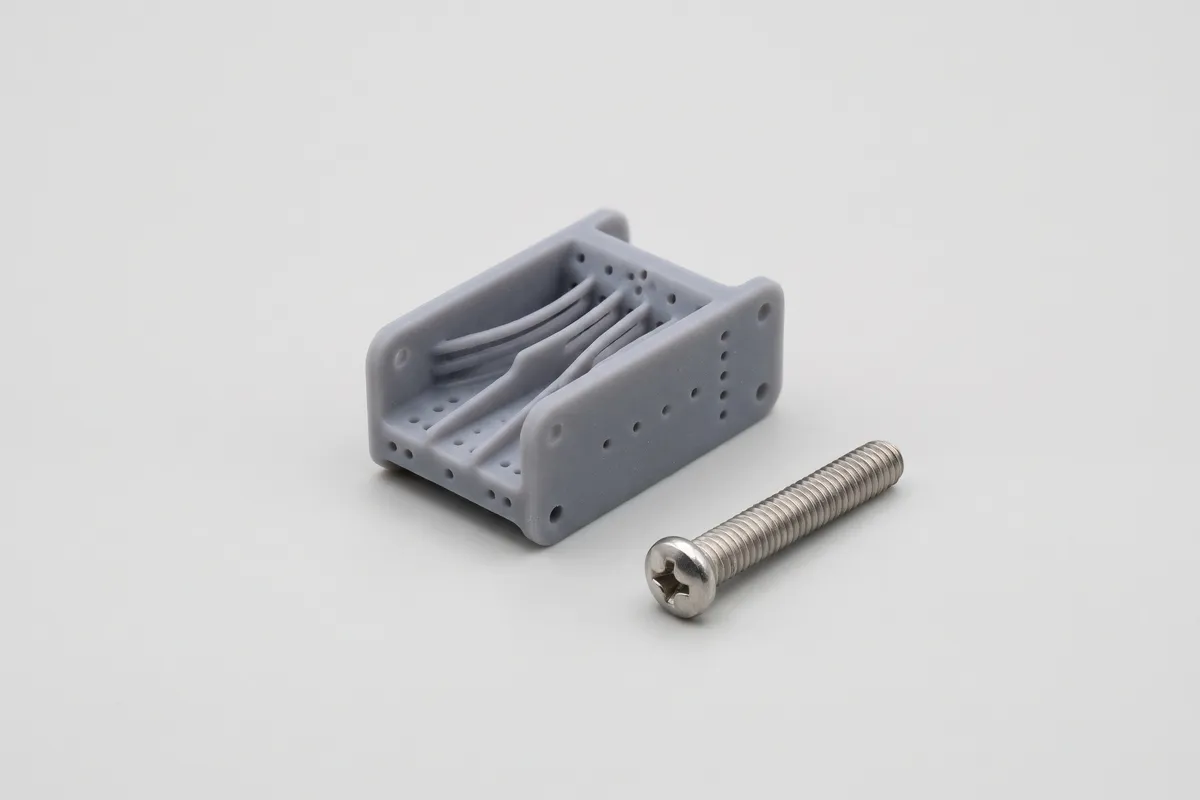
Standard Resin for appearance and design models
The smoothest surface for prototypes, trade fair models and master patterns for vacuum casting. For very fine details the grey version is recommended. Painting to Pantone can be ordered.Transparent Resin for see-through parts
Lenses, light guides, lamp parts and flow models in which you want to see what happens inside. All parts are polished as standard.Tough Resin for functional tests
Snap fits, clips and prototypes that have to withstand assembly and load, with the fine detail of resin.Ultra Detail for micro parts
The smallest components, fine engravings and microstructures with details from 0.1 mm, made by DLP on request.
Limits of resin.
Resins are thermosets: once cured they no longer melt, but they soften when heated. The heat deflection temperature of many resins is well below that of engineering thermoplastics. For Transparent Resin the data sheet states 49 °C under low load. Parts left in a warm car, next to a motor or in the sun can therefore deform.
Resins also fall short of thermoplastics in toughness. Standard Resin is stiff and hard, but breaks under impact more readily than polyamide. Tough Resin improves this but does not reach the toughness of PA12. Under long UV exposure, resins can also darken and become more brittle, so they are only suitable for outdoor use to a limited extent.
For functional parts that have to withstand load, heat or impact permanently, another process is therefore often better: SLS with polyamide 12 or FDM with fibre-reinforced plastics. Resin plays to its strengths in appearance, precision and detail.
Surface and post-processing of resin parts.
Resin parts leave the printer with a smooth, slightly satin surface. Only the contact points of the support structures remain visible, and they are sanded after removal. For appearance models it is therefore worth orienting the parts so that these points lie on surfaces that will not be seen.
Standard Resin can be painted to Pantone, which gives near-production samples for presentations, photos or customer meetings. Transparent Resin is polished as standard so that it becomes clear. Without polishing it looks milky because the surface scatters the light.
Because resin parts are so dimensionally accurate and smooth, they are often used as master patterns: as templates for silicone moulds, for fit checks or as reference parts for quality inspection. For fine mechanisms such as small gears and clips, choose Tough Resin or Ultra Detail, because Standard Resin tends to break when bent. Snap fits in Standard Resin only survive a few assemblies.
Design rules for resin parts.
SLA and DLP have a few rules of their own.
Cavities need drainage
Hollow parts need at least two openings so that liquid resin can drain and washing fluid can flow through. Enclosed parts are not possible.Plan for support structures
Resin parts are always printed with supports. The contact points remain visible as small marks. Tell us which surfaces are visible faces, and the supports will be placed on the back.Walls neither too thin nor too thick
Minimum walls from 0.4 to 1 mm depending on the resin. Very solid cross-sections build up stresses during curing; even wall thicknesses are better.Details above the minimum
Raised and recessed details should be larger than the minimum dimension of the chosen resin, otherwise they are lost during finishing.
Further reading.
Frequently asked questions.
- A liquid synthetic resin (photopolymer) that cures under UV light. SLA and DLP use it to make parts with a very smooth surface and fine details.
- With SLA a laser cures the layer along the contour; with DLP a projector exposes the whole layer at once. At Swiss3D the DLP resin achieves the finest details, from 0.1 mm.
- Stiff and hard, but less impact-resistant than polyamide. According to the data sheet, Tough Resin reaches 62 MPa tensile strength at 6.8% elongation at break and is suitable for functional tests.
- Only to a limited extent. Some resins soften at around 50 °C; according to the data sheet, Transparent Resin at 49 °C under low load.
- Yes. For Standard Resin, painting to Pantone can be ordered in the online quote. Transparent parts are polished as standard.
- The price depends on volume, size and resin. After upload, the online quote shows the price directly.
Order a resin part.
Upload your model and choose the right resin. Price and delivery time appear directly in the online quote; Ultra Detail on request.
Published on 22 November 2026.
Sources: Swiss3D, technical data sheet Standard Resin (SLA, German) · Swiss3D, technical data sheet Transparent Resin (SLA, German) · Swiss3D, technical data sheet Tough Resin (SLA, German) · Pagac et al., A Review of Vat Photopolymerization Technology: Materials, Applications, Challenges, and Future Trends of 3D Printing, Polymers (2021) · ISO/ASTM 52900:2021, Additive manufacturing – General principles – Fundamentals and vocabulary
Sample images created with AI.