FDM 3D printing
from PLA to PEEK.
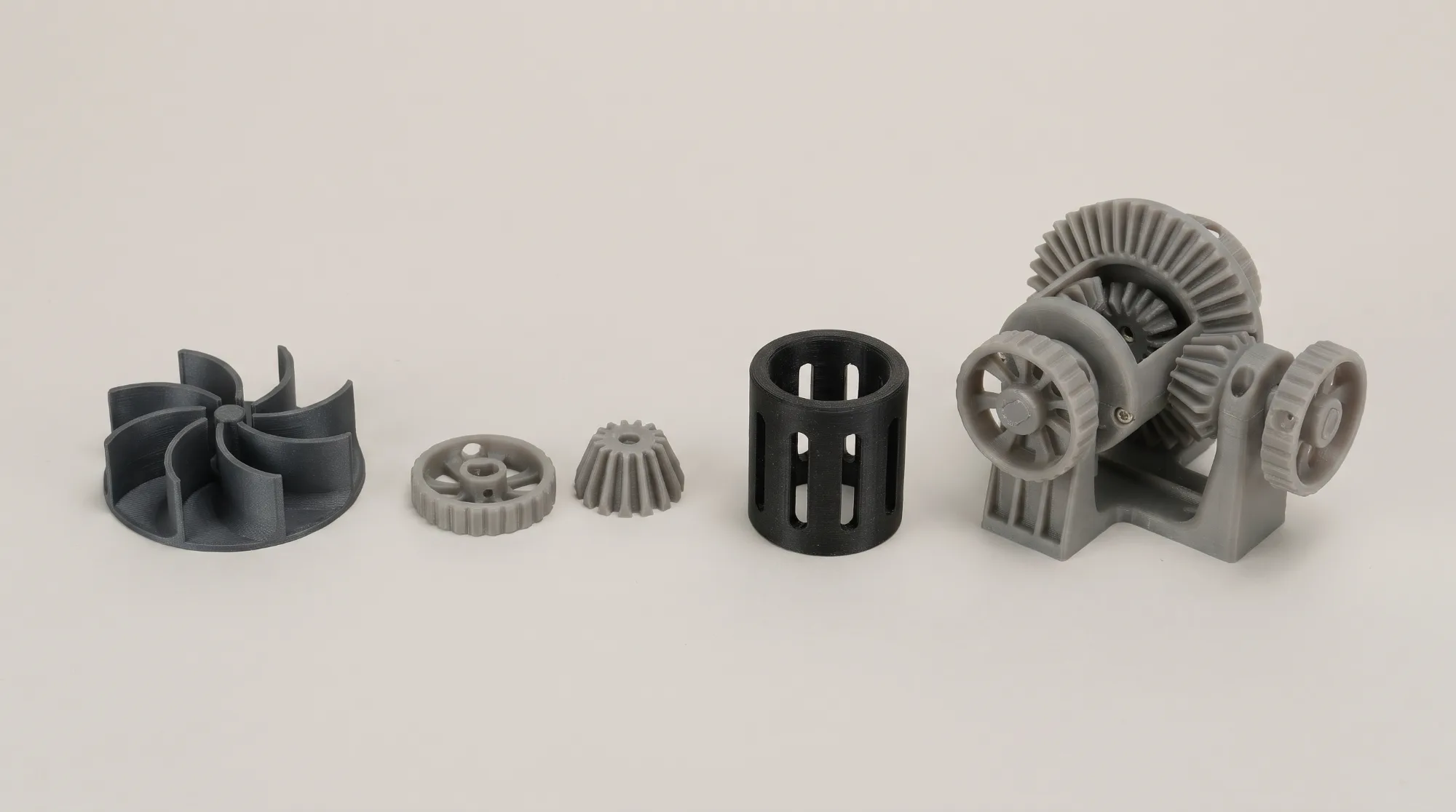
FDM parts in eleven plastics, from PLA for models to PA6-CF and PEEK for fixtures and hot environments. Upload a CAD file and get price and delivery date in seconds.
- Lead time 2–5 working days
- Build volume up to 800 × 800 × 800 mm
- Eleven materials up to PEEK
- Tolerance ±0.2 mm to ±0.3%






What is FDM 3D printing?
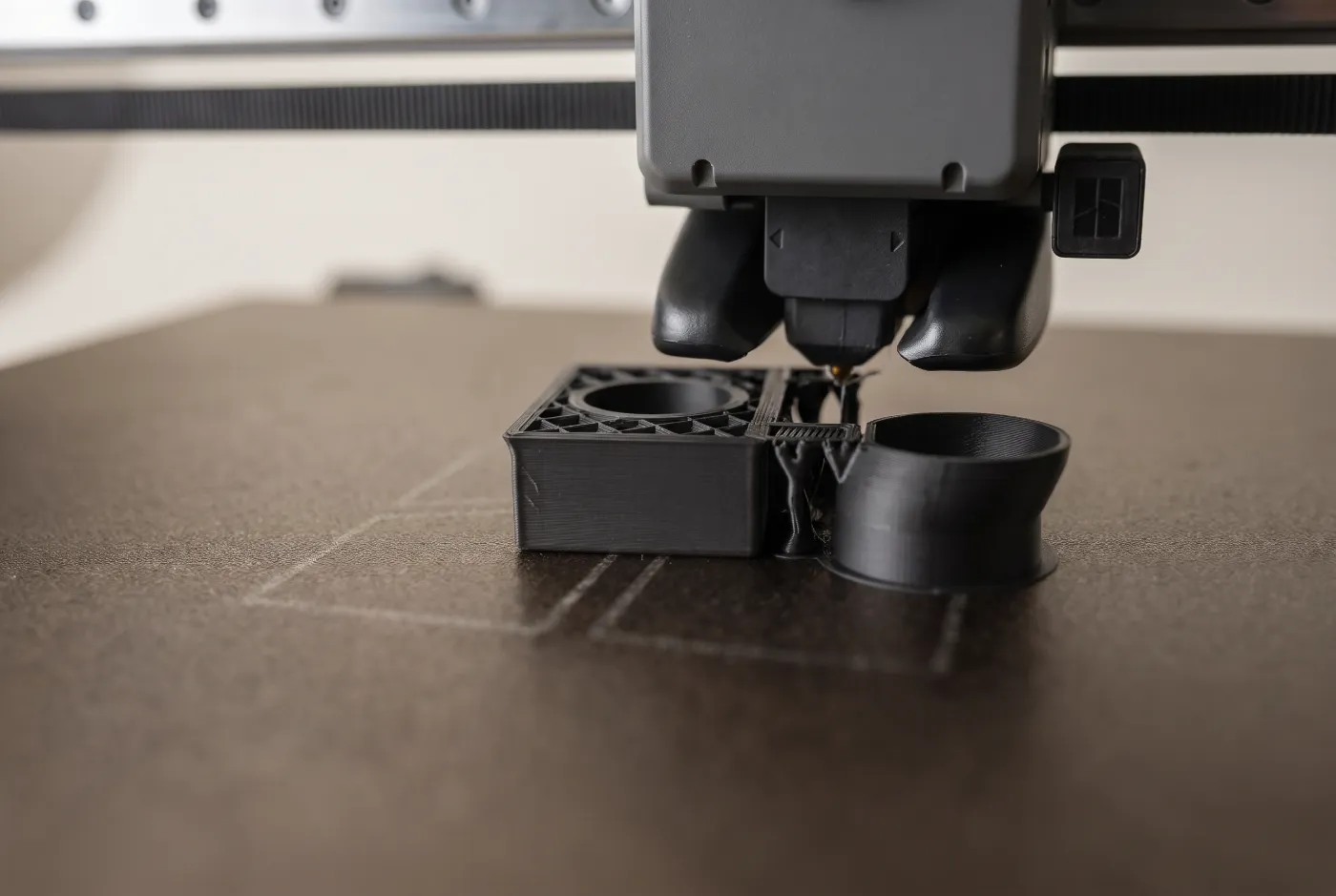
FDM, short for fused deposition modeling (also called FFF or material extrusion), is a 3D printing process in which a heated nozzle melts a thermoplastic filament and lays it down as a fine bead, layer by layer, on a build plate. It processes engineering plastics such as PETG, ASA, carbon-fibre nylon and PEEK and suits fixtures, brackets and large prototypes.
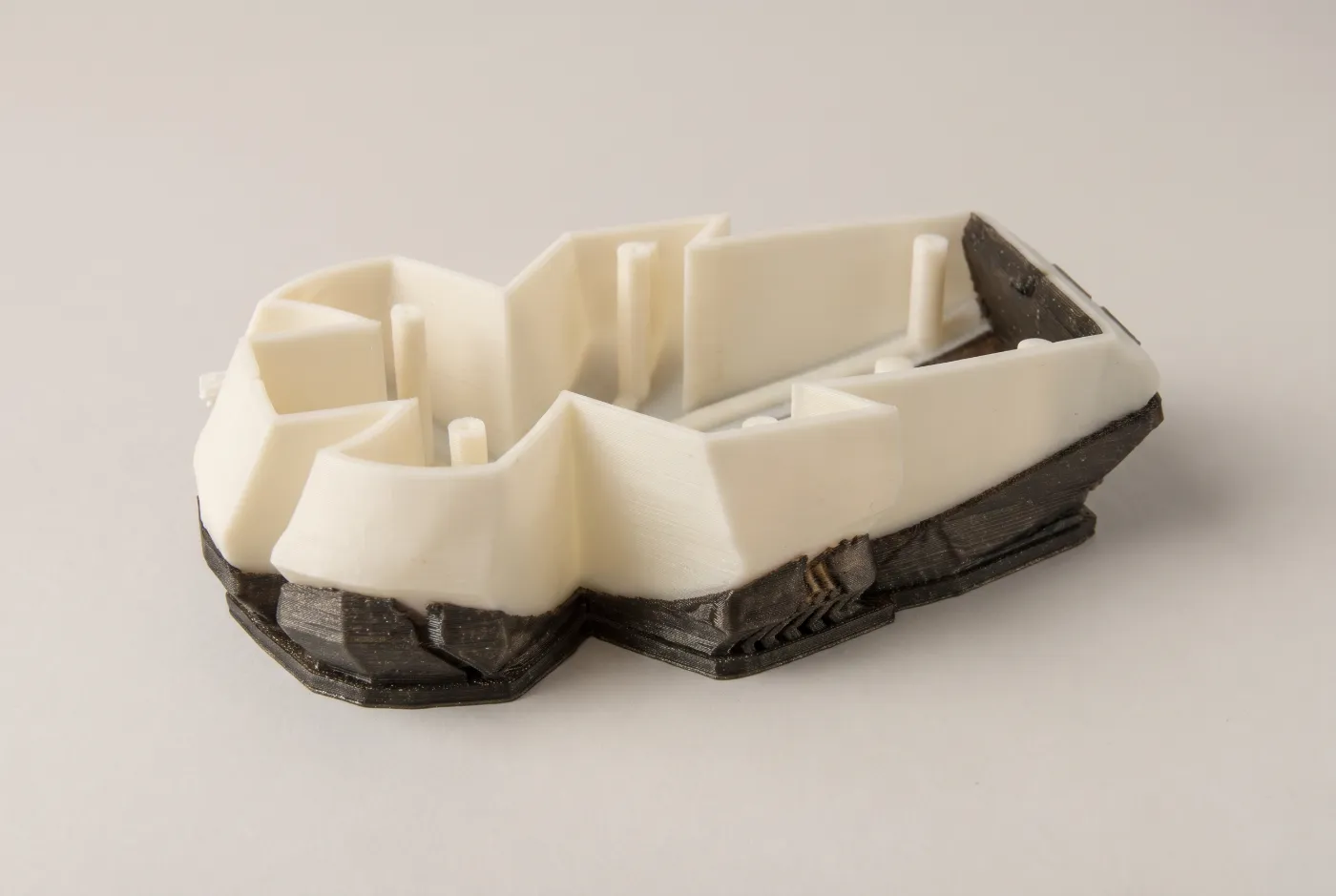
From the CAD file, the software calculates the toolpaths for each layer: closed outer walls and an infill inside. The nozzle traces these paths, the plastic solidifies immediately and the next layer follows, usually 0.2 mm higher. Surfaces flatter than about 45° above empty space need support structures, which are removed after printing.
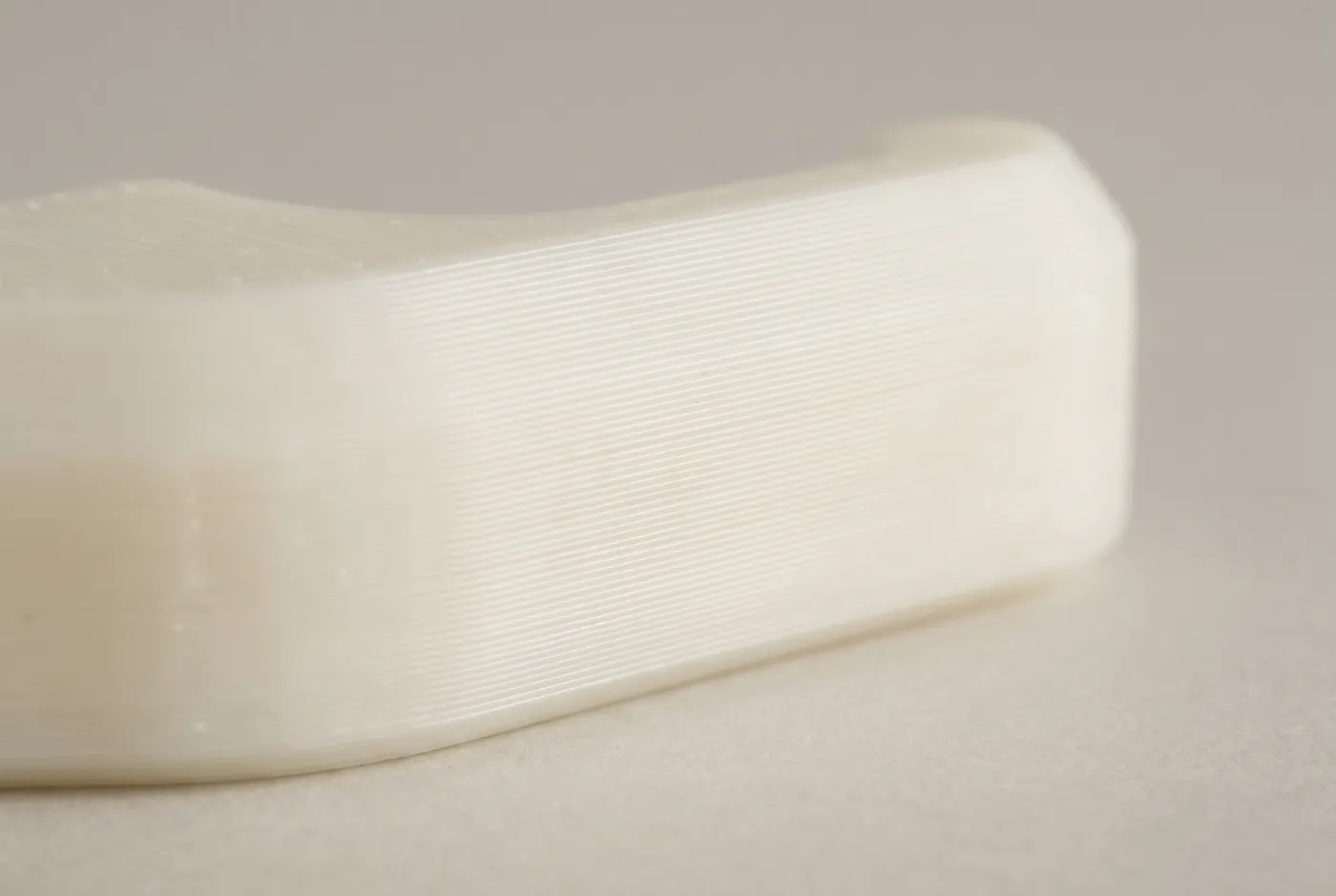
Because the part consists of fused beads, it is stronger within the layer plane than in the build direction, and the layer lines remain visible. Orientation in the build volume therefore determines strength. For functional parts with complex geometry, snap fits or loads from several directions, SLS is usually the better choice.
FDM materials.
Eleven filaments, from low-cost PLA to the high-performance plastic PEEK.
All materials in the Material FinderPLA
For visual models and first prototypes, not for loads, heat or outdoor use. HDT 58 °C (1.8 MPa), eight colours.PETG
Waterproof, resistant to oils and weak acids. For housings, brackets and covers. HDT 75 °C (1.8 MPa).ASA
UV- and weather-resistant for permanent outdoor use. HDT 100 °C (1.8 MPa).ABS-GF
Glass-fibre-reinforced ABS: stiff, dimensionally stable, low warping, matt surface. HDT 88 °C (1.8 MPa).PA12-CF
Carbon-fibre-reinforced nylon with low moisture absorption, for stiff fixtures and brackets. HDT 131 °C (0.45 MPa).PA6-GF
Glass-fibre-reinforced nylon that keeps its shape under heat: HDT 191 °C (0.45 MPa). For dry environments.PA6-CF
Very stiff and strong: tensile modulus 7453 MPa, tensile strength 105 MPa, HDT 215 °C (0.45 MPa).PPS-CF10
Flame-retardant to UL94 V0, resistant to oils, alkalis and fuels. HDT 252.5 °C (0.45 MPa). On request.PC-FR
Impact-resistant polycarbonate, flame-retardant to UL94 V0, for housings with fire protection requirements. HDT 107 °C (1.8 MPa). On request.PEEK
High-performance plastic for heat and chemicals: HDT 156 °C (1.8 MPa), tolerance ±0.1 mm. Lead time 7–10 working days.ABS-ESD7
Static-dissipative ABS (10⁴–10⁹ Ω) for fixtures and workpiece carriers in electronics production. On request.
Technical data for FDM printing.
Guide values per material. Exact values are listed on the individual material pages and in the datasheets.
Lead time
2–5 working days for PLA, PETG, ASA, ABS-GF and the nylons, PLA as express in 1–2 working days. PEEK 7–10 working days. PPS-CF10, PC-FR and ABS-ESD7 on request.Build volume
Up to 800 × 800 × 800 mm in PLA and PETG, up to 325 × 320 × 325 mm in ASA, ABS-GF and nylon. Other materials from 300 × 300 × 400 mm (PEEK) to 355 × 305 × 305 mm (ABS-ESD7).Layer height
Usually 0.1–0.25 mm: standard 0.2 mm, fine 0.12 mm, down to 0.06 mm for PA12-CF.Tolerance
±0.2% for the nylons, ±0.3% for PETG, ASA and ABS-GF, ±0.2 mm for PLA, ±0.1 mm for PEEK.Heat deflection temperature (HDT)
At 0.45 MPa from 60 °C (PLA) to 252.5 °C (PPS-CF10), at 1.8 MPa from 58 °C (PLA) to 173 °C (PA6-CF).Tensile strength
Within the layer plane from about 35 MPa (ABS-GF, ABS-ESD7) to 105 MPa (PA6-CF, PEEK), lower in the build direction.Quantity
From a single piece, with no tooling costs.
Values from the datasheets, measured within the layer plane (X-Y). On a printed part they depend on geometry, orientation and infill.
Information as of: November 2026
Applications for FDM 3D printing.
For fairly simple parts that are needed quickly, in a large size or in a specific engineering plastic.
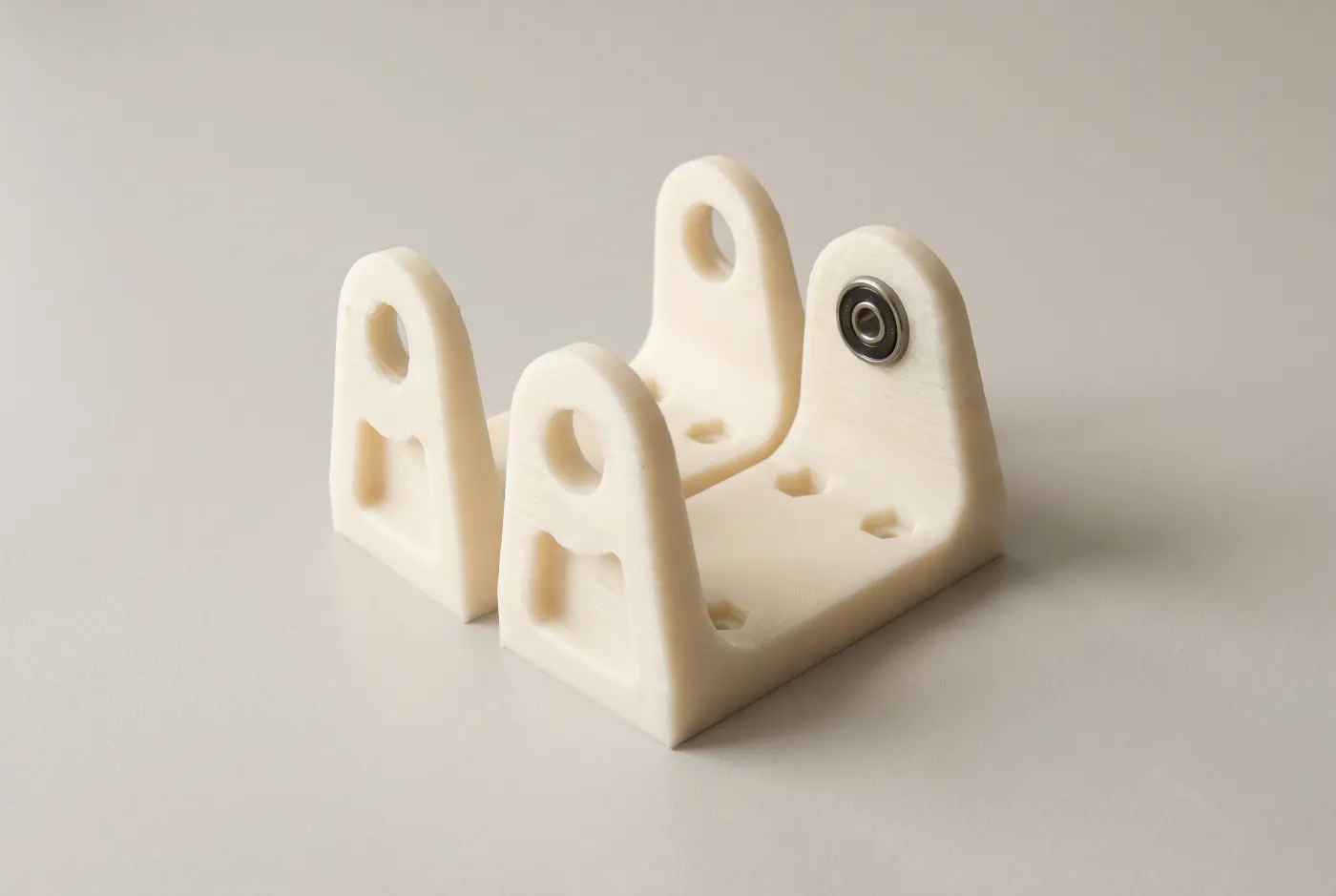
Fixtures and gauges
Assembly, drilling and inspection fixtures in PA12-CF or PA6-CF, stiff and on the line within a few days. For electronics production in static-dissipative ABS-ESD7.Brackets and housings
Holders, covers and housings with a simple shape in PETG or ABS-GF, in ASA for outdoor use.Heat, chemicals, fire protection
PA6-GF and PA6-CF close to heat sources, PPS-CF10 and PEEK for oil and fuel, PC-FR where UL94 V0 is required.Large prototypes
Design and functional samples up to 800 × 800 × 800 mm in PLA or PETG.
FDM, SLS, MJF and SLA compared.
The four plastic processes side by side, with values for the standard materials.
| Criterion | SLS | MJF | SLA | FDM |
|---|---|---|---|---|
| Principle | Laser sinters plastic powder | Infrared fuses the whole powder layer | UV light cures liquid resin | Nozzle deposits molten plastic |
| Materials | PA12, PA12-GF, TPU 88A | PA12 | Standard, clear and tough resin, DLP | Eleven, from PLA to PEEK |
| Surface | Matte, slightly grainy | Matte, fine-grained, slightly smoother | Smooth, layers barely visible | Visible layer lines |
| Accuracy | ±0.3% | ±0.3% | ±0.1–0.3%, DLP ±0.05% | ±0.2 mm to ±0.3% |
| Layer thickness | 0.1 mm | 0.08 mm | 0.05–0.1 mm | 0.1–0.25 mm |
| Strength | Tough, similar in all directions | Tough, similar in all directions | Stiff, standard resin rather brittle | Lower across the layers |
| Support structures | None, the powder supports | None, the powder supports | Always, contact points visible | On overhangs from about 45° |
| Largest parts | 700 × 380 × 580 mm | 284 × 350 × 350 mm | 1700 × 900 × 800 mm | 800 × 800 × 800 mm |
| Lead time | PA12 dark grey 2–5, otherwise 5–10 working days | 7–10 working days | 7–10 working days, DLP on request | 2–5 working days, PEEK 7–10 |
| Typical parts | Functional parts, clips, complex housings | Series parts, housings, brackets | Visual models, fine parts, clear parts | Fixtures, brackets, large prototypes |
| Cost | Medium | Medium, lower in series | Medium | Low (PLA, PETG) to high (PEEK) |
Principle
- SLS
- Laser sinters plastic powder
- MJF
- Infrared fuses the whole powder layer
- SLA
- UV light cures liquid resin
- FDM
- Nozzle deposits molten plastic
Materials
- SLS
- PA12, PA12-GF, TPU 88A
- MJF
- PA12
- SLA
- Standard, clear and tough resin, DLP
- FDM
- Eleven, from PLA to PEEK
Surface
- SLS
- Matte, slightly grainy
- MJF
- Matte, fine-grained, slightly smoother
- SLA
- Smooth, layers barely visible
- FDM
- Visible layer lines
Accuracy
- SLS
- ±0.3%
- MJF
- ±0.3%
- SLA
- ±0.1–0.3%, DLP ±0.05%
- FDM
- ±0.2 mm to ±0.3%
Layer thickness
- SLS
- 0.1 mm
- MJF
- 0.08 mm
- SLA
- 0.05–0.1 mm
- FDM
- 0.1–0.25 mm
Strength
- SLS
- Tough, similar in all directions
- MJF
- Tough, similar in all directions
- SLA
- Stiff, standard resin rather brittle
- FDM
- Lower across the layers
Support structures
- SLS
- None, the powder supports
- MJF
- None, the powder supports
- SLA
- Always, contact points visible
- FDM
- On overhangs from about 45°
Largest parts
- SLS
- 700 × 380 × 580 mm
- MJF
- 284 × 350 × 350 mm
- SLA
- 1700 × 900 × 800 mm
- FDM
- 800 × 800 × 800 mm
Lead time
- SLS
- PA12 dark grey 2–5, otherwise 5–10 working days
- MJF
- 7–10 working days
- SLA
- 7–10 working days, DLP on request
- FDM
- 2–5 working days, PEEK 7–10
Typical parts
- SLS
- Functional parts, clips, complex housings
- MJF
- Series parts, housings, brackets
- SLA
- Visual models, fine parts, clear parts
- FDM
- Fixtures, brackets, large prototypes
Cost
- SLS
- Medium
- MJF
- Medium, lower in series
- SLA
- Medium
- FDM
- Low (PLA, PETG) to high (PEEK)
Guide values for the standard materials; values for each material in the Material Finder. SLS in 2–5 working days applies to PA12 dark grey up to 165 × 165 × 300 mm.
Design rules for FDM printing.
Minimum values from the material data. Thinner walls, smaller holes and finer details are not reliably reproduced.
Wall thickness
At least 1 mm, 1.2 mm for PC-FR, 1.5 mm for PEEK and PPS-CF10, 2 mm if unsupported.Holes
From 1 mm, from 1.5 mm for PC-FR and ABS-ESD7, from 2 mm for PLA, PEEK and PPS-CF10. Printed holes come out slightly undersize; drill or ream fits.Details
Embossed and engraved details from 0.3 mm (PEEK, PPS-CF10) to 0.6 mm (PLA, ABS-ESD7).Overhangs and bridges
Surfaces flatter than about 45° need supports, which leave marks on the underside. FDM prints short bridges freely; chamfers instead of horizontal overhangs save supports.Orientation and load
Datasheet values apply within the layer plane. Tensile strength drops in the build direction, from 59.4 to 32 MPa for PPS-CF10. Place the main load and snap fits in the layer plane.Gaps and enclosed parts
Clearance between parts at least 0.5 mm for PLA, PC-FR, PEEK and PPS-CF10, otherwise 1 mm. Enclosed parts only in PLA, PETG, ASA and ABS-GF.
Surface finish and post-processing of FDM parts.
As printed
Fine layer lines, supported undersides rougher than the top. PETG and ASA are glossy, ABS-GF and the carbon materials are matt and hide the layers.Coatings
Clear lacquer and transparent protective coatings against UV radiation or against water and gas, available for most materials.Annealing
For PA12-CF, PA6-GF, PA6-CF and PPS-CF10: the heat treatment increases stiffness and heat resistance. The part may shrink by approx. 1–3%.
When a process other than FDM fits better.
Complex functional parts
Undercuts, internal channels, snap fits and moving assemblies: SLS needs no supports and has similar strength in all directions.Flexible parts in TPU
Seals, buffers and grips are made in TPU 88A using SLS, with walls from 0.5 mm.Series of identical parts
From medium quantities, many parts share one build volume. MJF PA12 is designed for series parts.Smooth visible surfaces
SLA delivers smooth surfaces and ±0.1–0.3% depending on the resin, for visual models and fit samples.Metal instead of plastic
Where strength or temperature go beyond PEEK: aluminium, stainless steel and titanium by laser powder bed fusion.
Frequently asked questions.
- The price depends on material, volume, support structures and print time, which grows mainly with build height. PLA costs least, PETG is the lowest-cost functional material and PEEK the most expensive. Upload your CAD file and the price appears in seconds, from a single piece and with no tooling costs.
- Depending on the material, ±0.2% for the nylons, ±0.3% for PETG, ASA and ABS-GF and ±0.1 mm for PEEK. Printed holes come out slightly undersize, so fits are drilled or reamed after printing.
- Within the layer plane, carbon-fibre-reinforced PA6-CF reaches a tensile strength of 105 MPa with a tensile modulus of 7453 MPa. Adhesion between layers is lower: for PPS-CF10, tensile strength in the build direction drops from 59.4 to 32 MPa. For loads from several directions, SLS is therefore often the safer choice.
- SLS, if the geometry is complex, has snap fits or internal channels, or the load comes from several directions, because the powder supports the part. FDM, if the part is large and simple or needs a material that only exists as filament, such as PEEK, PC-FR or ABS-ESD7. For series of identical parts, MJF is also an option.
- ASA: it replaces the butadiene in ABS with acrylate and is therefore UV- and weather-resistant, HDT 100 °C at 1.8 MPa. PETG is waterproof and suitable for indoor and outdoor parts, but its HDT is only 75 °C (1.8 MPa). ABS is available as stiff ABS-GF and as static-dissipative ABS-ESD7, neither intended for permanent UV exposure.
- Yes, flexible parts in TPU 88A are made using SLS, not FDM. Without supports, lattice structures, seals and buffers with walls from 0.5 mm are also possible. The lead time is 7–10 working days.
- PLA, PETG, ASA, ABS-GF and the nylons in 2–5 working days, PLA as express in 1–2 working days. PEEK takes 7–10 working days; PPS-CF10, PC-FR and ABS-ESD7 are available on request. After upload, the online quoting tool shows the exact delivery date.
Price your FDM part.
Upload a CAD file and get price and delivery date in seconds. For PPS-CF10, PC-FR, ABS-ESD7 and series production, send us an inquiry.