SLS 3D printing
for functional parts and small series.
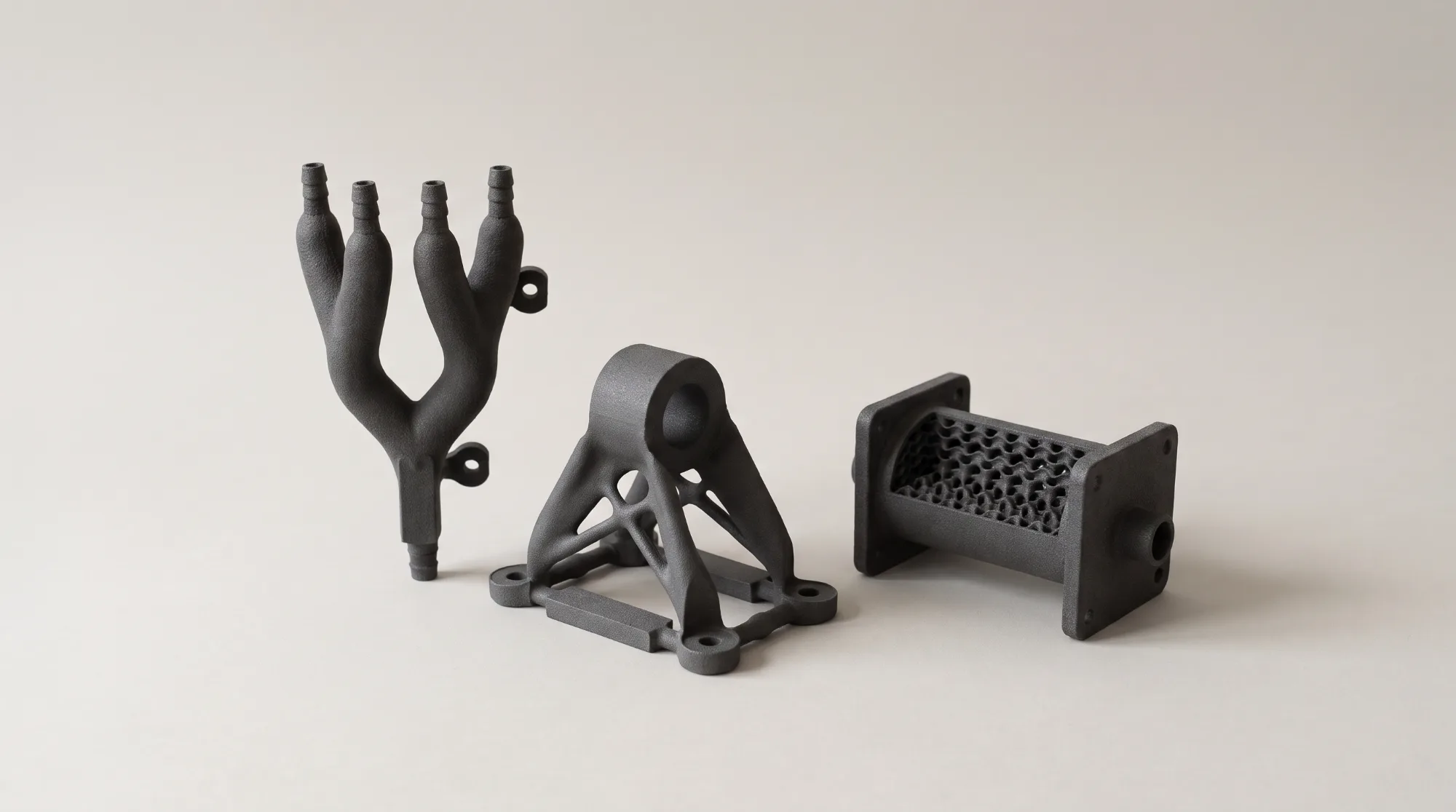
Strong plastic parts in PA12, PA12-GF and TPU made by selective laser sintering, without support structures and from a single piece. Upload a CAD file and get price and delivery date in seconds.
- PA12 dark grey in 2–5 working days
- Parts up to 700 × 380 × 580 mm
- Tolerance ±0.3%
- No support structures






How SLS printing works.
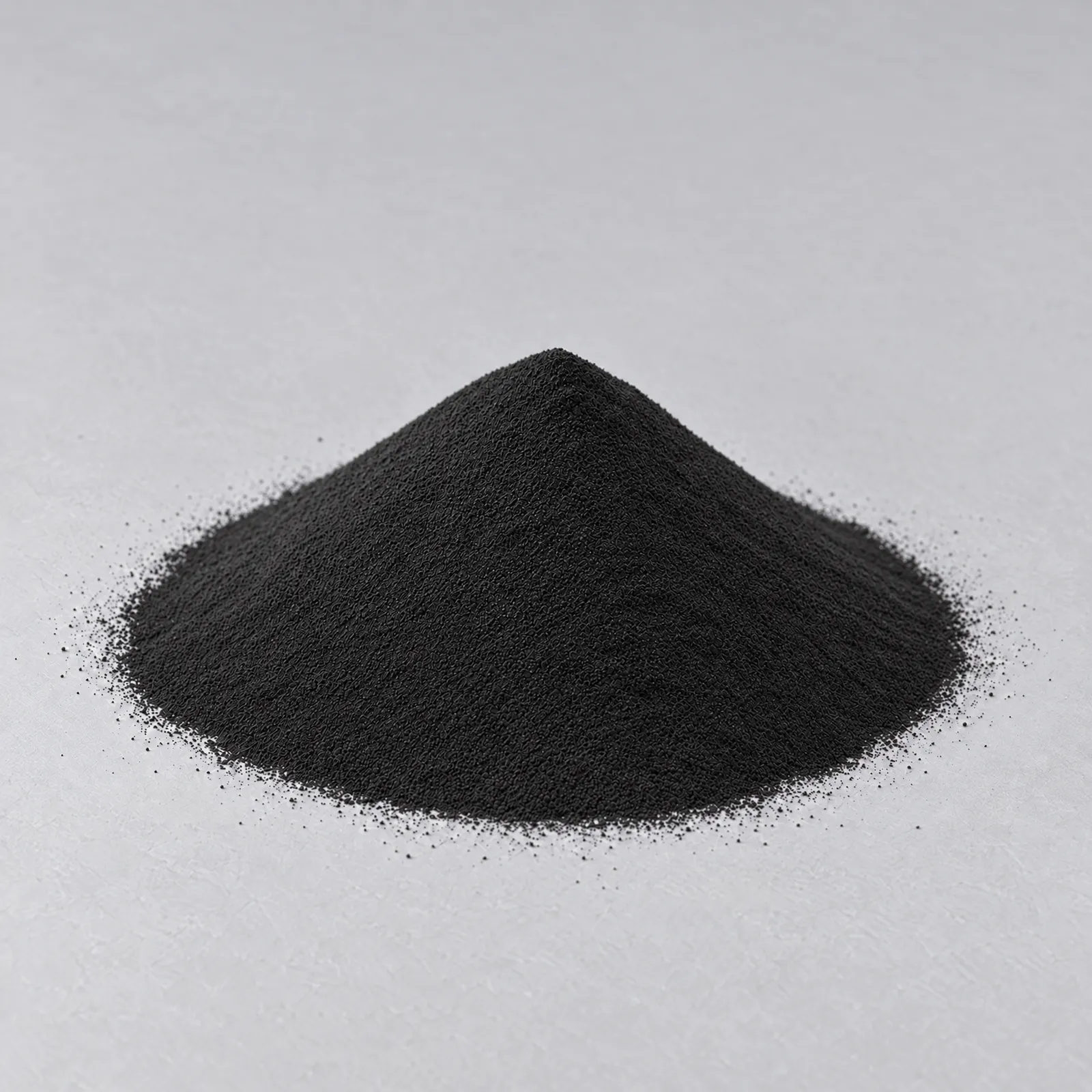
SLS, or selective laser sintering, is a 3D printing process in which a laser fuses fine plastic powder, usually nylon (polyamide 12, PA12), layer by layer. The unsintered powder supports the part during printing, so SLS needs no support structures. The result is strong functional parts with complex geometry, as single pieces or small series.
A recoater spreads a 0.1 mm layer of powder. The laser traces the cross-section of each part and fuses the powder, preheated to just below its melting point, at those points. The platform then lowers by one layer and the cycle repeats until all parts are complete.
Once cooled, the parts are unpacked from the powder cake and cleaned of loose powder. Because they sit freely in the powder, many parts fit side by side and on top of each other in one build. This makes SLS economical for small series too, without tooling.
SLS materials.
Three powder materials cover most applications: tough, stiff or rubber-like.
All materials in the Material FinderSLS PA12
The standard material for functional parts. Tough, with 46 MPa tensile strength and 36% elongation at break, HDT 145 °C (0.45 MPa). In dark grey, black and white, parts up to 700 × 380 × 580 mm.SLS PA12-GF
PA12 filled with glass beads: with a tensile modulus of 3500 MPa, more than twice as stiff as PA12, HDT 160 °C (0.45 MPa), little warpage. For rigid housings, brackets and fixtures. Not for snap-fits, as elongation at break is 5%. White, up to 330 × 330 × 380 mm.SLS TPU 88A
Rubber-like, with a Shore hardness of 88–90 A and up to 280% elongation at break. Withstands 100,000 flex cycles without crack growth. For seals, buffers, grips and flexible covers. White, up to 500 × 500 × 820 mm.
SLS technical data.
Typical values for SLS PA12 according to the data sheet, measured on standard test specimens.
Layer thickness
0.1 mmAccuracy
±0.3% of the dimensionPart size
PA12 up to 700 × 380 × 580 mm, TPU 88A up to 500 × 500 × 820 mm, PA12-GF up to 330 × 330 × 380 mmLead time
PA12 dark grey up to 165 × 165 × 300 mm: 2–5 working days, express 1–3. Black in this size: 5–8 working days, express 4–6. Other colours and sizes: 7–10 working days.Tensile strength
46 MPaElongation at break
36%Tensile modulus
1600 MPaHeat deflection temperature
145 °C at 0.45 MPa (HDT-B), 82 °C at 1.8 MPa (HDT-A)Chemical resistance
Resistant to oils and greases, limited resistance to weak acids and alkalis
The properties of a part depend on its geometry and orientation in the build volume and may differ. Elongation at break is usually lower in the build direction.
Information as of: November 2026
When SLS 3D printing pays off.
For plastic parts that carry mechanical loads, have a complex shape or are needed in small series.
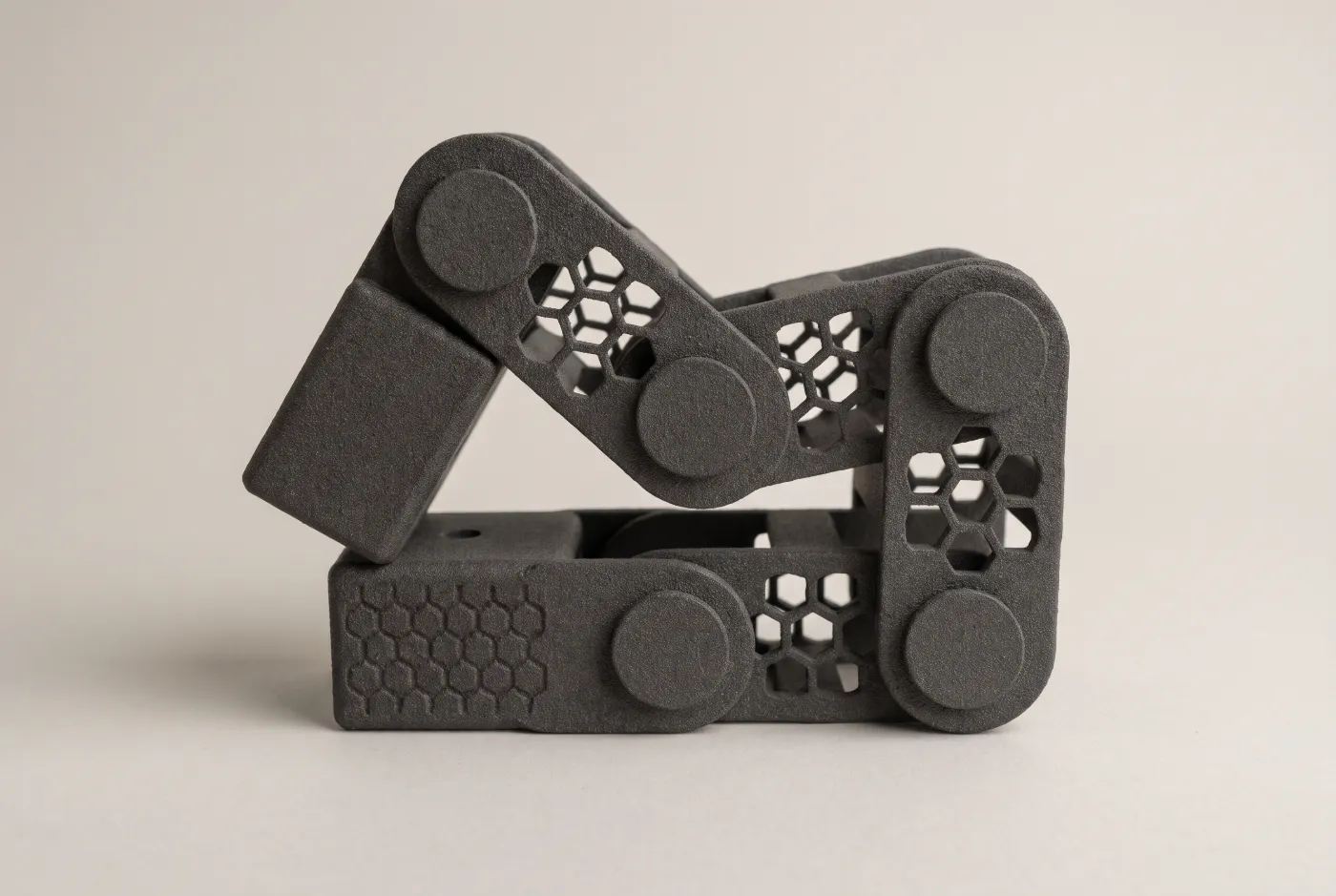
Functional prototypes
Prototypes that behave like end-use parts: check fit, assembly and load on the real part.Small series without tooling
No tooling costs and no minimum order, from a single part to a small series.Housings, clips and snap-fits
PA12 is tough enough for clips, snap-fits and hinges that are opened again and again.Complex shapes
Internal channels, undercuts, lattice structures and moving assemblies in one print, without assembly.Jigs, fixtures and grippers
Assembly aids, gripper fingers and inspection gauges for production; rigid versions in PA12-GF.Seals and dampers
Gaskets, buffers and soft grips in TPU 88A, without a mould.
SLS, MJF, SLA and FDM compared.
All four processes produce plastic parts, each with its own strengths. For strong parts with complex shapes, SLS is usually the first choice.
| Criterion | SLS | MJF | SLA | FDM |
|---|---|---|---|---|
| Principle | Laser sinters plastic powder | Infrared fuses the whole powder layer | UV light cures liquid resin | Nozzle deposits molten plastic |
| Materials | PA12, PA12-GF, TPU 88A | PA12 | Standard, clear and tough resin, DLP | Eleven, from PLA to PEEK |
| Surface | Matte, slightly grainy | Matte, fine-grained, slightly smoother | Smooth, layers barely visible | Visible layer lines |
| Accuracy | ±0.3% | ±0.3% | ±0.1–0.3%, DLP ±0.05% | ±0.2 mm to ±0.3% |
| Layer thickness | 0.1 mm | 0.08 mm | 0.05–0.1 mm | 0.1–0.25 mm |
| Strength | Tough, similar in all directions | Tough, similar in all directions | Stiff, standard resin rather brittle | Lower across the layers |
| Support structures | None, the powder supports | None, the powder supports | Always, contact points visible | On overhangs from about 45° |
| Largest parts | 700 × 380 × 580 mm | 284 × 350 × 350 mm | 1700 × 900 × 800 mm | 800 × 800 × 800 mm |
| Lead time | PA12 dark grey 2–5, otherwise 5–10 working days | 7–10 working days | 7–10 working days, DLP on request | 2–5 working days, PEEK 7–10 |
| Typical parts | Functional parts, clips, complex housings | Series parts, housings, brackets | Visual models, fine parts, clear parts | Fixtures, brackets, large prototypes |
| Cost | Medium | Medium, lower in series | Medium | Low (PLA, PETG) to high (PEEK) |
Principle
- SLS
- Laser sinters plastic powder
- MJF
- Infrared fuses the whole powder layer
- SLA
- UV light cures liquid resin
- FDM
- Nozzle deposits molten plastic
Materials
- SLS
- PA12, PA12-GF, TPU 88A
- MJF
- PA12
- SLA
- Standard, clear and tough resin, DLP
- FDM
- Eleven, from PLA to PEEK
Surface
- SLS
- Matte, slightly grainy
- MJF
- Matte, fine-grained, slightly smoother
- SLA
- Smooth, layers barely visible
- FDM
- Visible layer lines
Accuracy
- SLS
- ±0.3%
- MJF
- ±0.3%
- SLA
- ±0.1–0.3%, DLP ±0.05%
- FDM
- ±0.2 mm to ±0.3%
Layer thickness
- SLS
- 0.1 mm
- MJF
- 0.08 mm
- SLA
- 0.05–0.1 mm
- FDM
- 0.1–0.25 mm
Strength
- SLS
- Tough, similar in all directions
- MJF
- Tough, similar in all directions
- SLA
- Stiff, standard resin rather brittle
- FDM
- Lower across the layers
Support structures
- SLS
- None, the powder supports
- MJF
- None, the powder supports
- SLA
- Always, contact points visible
- FDM
- On overhangs from about 45°
Largest parts
- SLS
- 700 × 380 × 580 mm
- MJF
- 284 × 350 × 350 mm
- SLA
- 1700 × 900 × 800 mm
- FDM
- 800 × 800 × 800 mm
Lead time
- SLS
- PA12 dark grey 2–5, otherwise 5–10 working days
- MJF
- 7–10 working days
- SLA
- 7–10 working days, DLP on request
- FDM
- 2–5 working days, PEEK 7–10
Typical parts
- SLS
- Functional parts, clips, complex housings
- MJF
- Series parts, housings, brackets
- SLA
- Visual models, fine parts, clear parts
- FDM
- Fixtures, brackets, large prototypes
Cost
- SLS
- Medium
- MJF
- Medium, lower in series
- SLA
- Medium
- FDM
- Low (PLA, PETG) to high (PEEK)
Guide values for the standard materials; values for each material in the Material Finder. SLS in 2–5 working days applies to PA12 dark grey up to 165 × 165 × 300 mm.
SLS design guidelines.
Minimum values for SLS PA12 and PA12-GF; TPU 88A allows thinner walls and smaller holes.
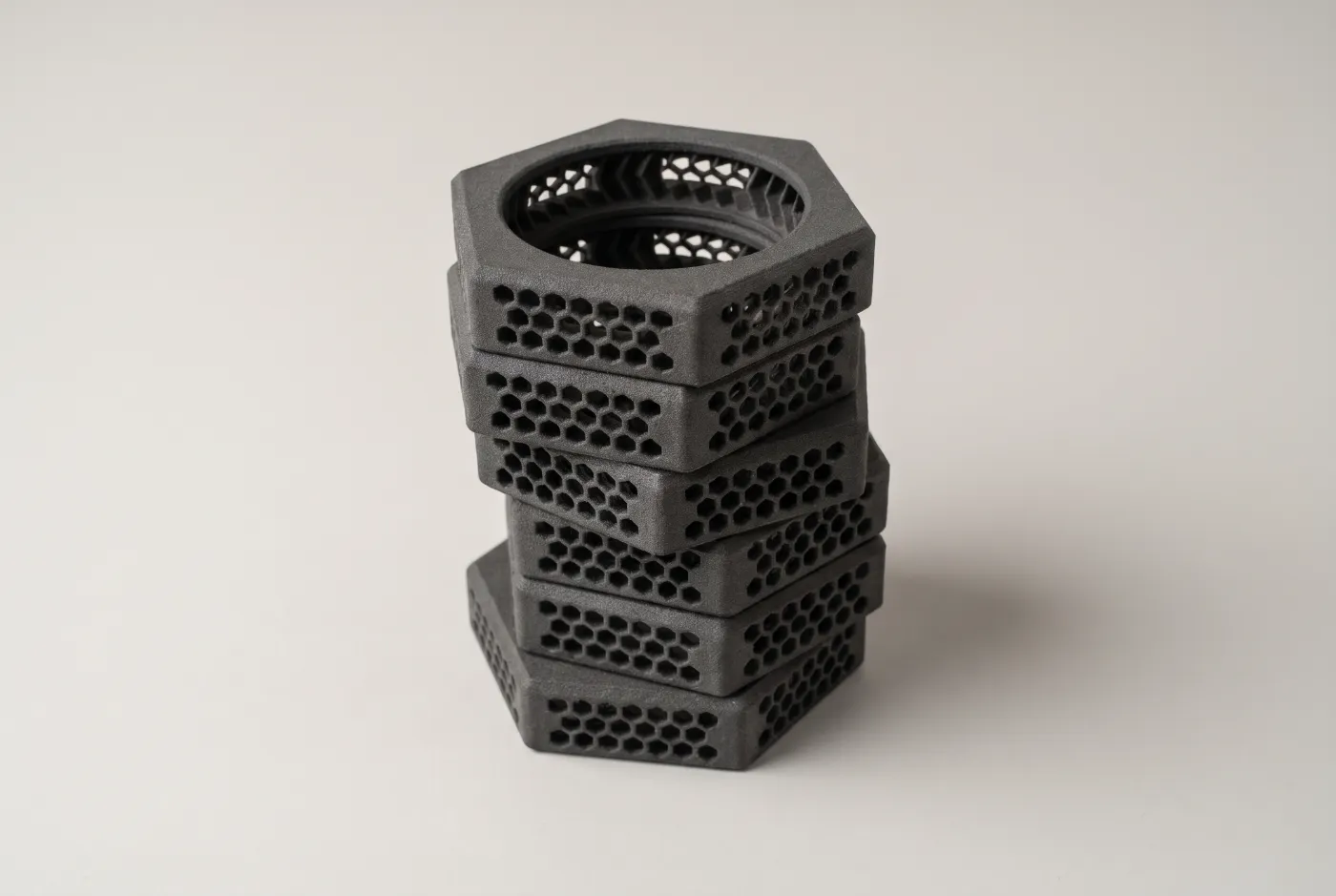
Wall thickness
At least 1.0 mm for supported walls, 1.5 mm for unsupported walls. TPU 88A from 0.5 mm.Pins and struts
From 0.8 mm diameter if connected at both ends, otherwise from 1.0 mm.Holes
From 1.0 mm diameter (TPU 88A from 0.5 mm). Through holes need a clear line of sight so that the powder can be removed.Details and lettering
Embossed and engraved details from 0.4 mm. Lettering is clearly legible from 0.6 mm relief depth.Clearance and moving parts
At least 0.5 mm between parts, walls and struts (TPU 88A 1.0 mm). Joints and captive parts can be printed in one piece.Hollow parts
Hollow parts need openings so that the unsintered powder can be removed. Otherwise it stays trapped inside.Large flat areas
Large plates and solid blocks can warp as they cool. Use ribs instead of solid material, or choose PA12-GF, which warps less.
SLS surface finishes and post-processing.
As printed
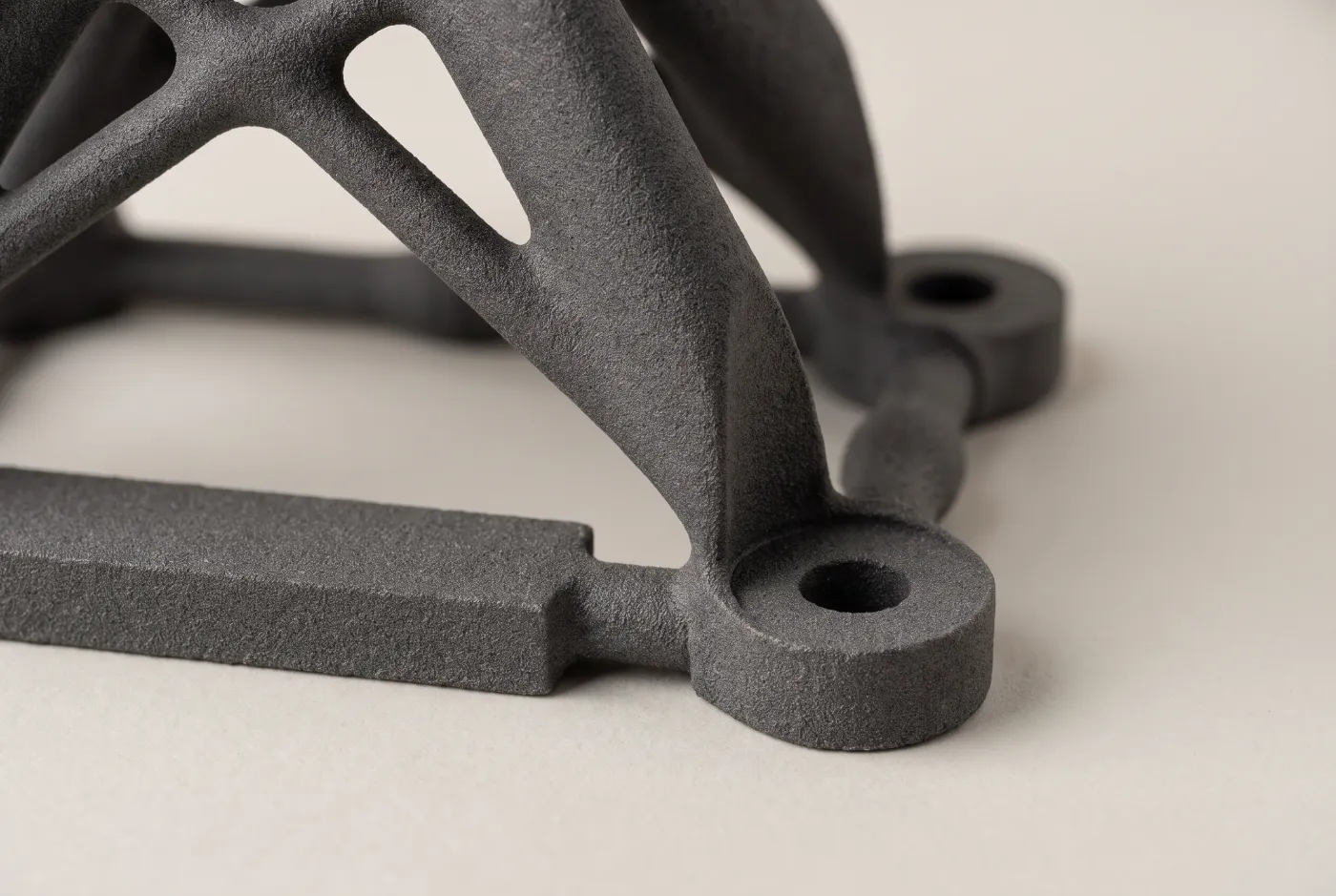
Matt and slightly grainy, the same on all sides, with no support marks. Slightly rougher than MJF; for smooth visible parts, SLA is the better choice.Dyed black
Immersion dyeing for the white materials PA12-GF and TPU 88A. The dye penetrates the surface and the dimensions stay the same.Coated
Clear coat, UV protection for outdoor parts and a sealant against water and gas for tight housings.
When a process other than SLS fits better.
Smooth visible parts
For fine details and paintable surfaces, SLA is the better choice.Larger quantities in grey or black
Also PA12 with the same data sheet values and a slightly smoother surface. Whether MJF costs less depends on the shape; the online quoting tool lets you compare both.Simple parts on a tight budget
Concept models and simple brackets without high requirements cost less with FDM.Parts larger than the build volume
Parts that do not fit into the SLS build volume are made by large-format printing.Metal or high temperatures
Where plastic reaches its limits, aluminium, stainless steel or titanium in metal 3D printing are suitable.Tight tolerances, simple geometry
Fits tighter than ±0.3% and prismatic parts are more accurate, and often cheaper, when milled.
Frequently asked questions.
- The price depends mainly on the volume and size of the part and on the quantity. Upload your STEP or STL file and the price appears in seconds. From a single piece, with no tooling costs.
- PA12 in dark grey up to 165 × 165 × 300 mm takes 2–5 working days, or 1–3 with express. Black in this size takes 5–8 working days. Other colours and sizes, PA12-GF and TPU 88A: 7–10 working days. After upload, the online quoting tool shows the exact delivery date.
- Dimensional accuracy is ±0.3% of the dimension, with a layer thickness of 0.1 mm. Plan at least 0.5 mm clearance for fits and moving parts. For tighter tolerances, CNC milling is the better option.
- Both fuse PA12 powder without support structures and reach the same strength values according to the data sheet. With 0.08 mm layers, MJF gives a slightly smoother surface, in grey or black. SLS offers the larger build volume, white, PA12-GF and TPU, and shorter lead times for PA12 in dark grey.
- FDM is cheaper for simple parts and concept models. As soon as a part carries loads, has undercuts or internal channels, or is needed in small series, SLS is usually the better choice: it needs no supports, and its strength depends less on the print direction.
- SLS PA12 is slightly porous and not reliably tight without treatment. For tight housings, a sealant against water and gas is available. According to the manufacturer's tests, TPU 88A is watertight from a wall thickness of 0.6 mm.
- Yes, with brass threaded inserts (M1.6 to M8) or stainless steel Helicoil inserts (M2 to M10). They carry more load and can be screwed more often than a printed thread. You select the inserts in the online quoting tool.
- Yes, for small series and end-use parts. Many parts share one build, there are no tooling costs, and a design change only needs a new file. For larger quantities in grey or black, it is worth comparing with MJF.
Price your SLS part.
Upload a CAD file and get price and delivery date in seconds. For series production and special requirements, send us an inquiry.