PA12 in 3D printing.
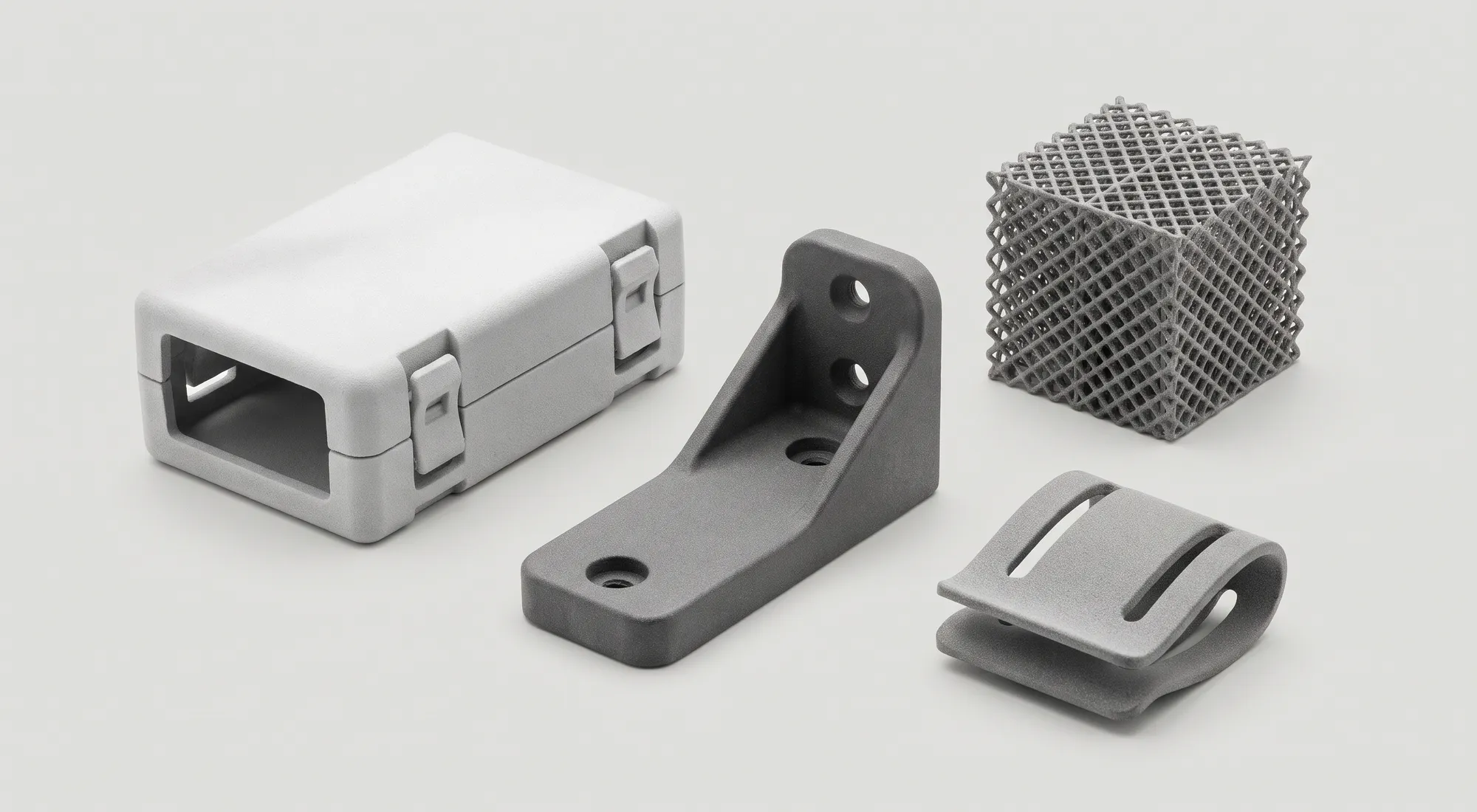
PA12 (polyamide 12, also nylon 12) is the most widely used plastic in industrial 3D printing: tough, light, chemically resistant to oils and greases, and dimensionally stable thanks to low water absorption. PA12 is mainly printed as powder with SLS and MJF, and reinforced with glass or carbon fibre also for stiffer parts.
- SLS up to 700 × 380 × 580 mm
- Printed without support structures
- Glass- and carbon-reinforced versions
- Threaded inserts can be ordered directly






What makes PA12 the standard material.
Polyamide 12 is a semi-crystalline thermoplastic with a melting point of 183 °C. It combines properties that rarely come together: it is tough and does not break in a brittle way, it can be bent in thin walls and loaded in thick cross-sections, and it absorbs less water than other common polyamides such as PA6. Parts therefore keep their dimensions even when the humidity changes.
According to the data sheet, printed PA12 parts are resistant to oils and greases, partly resistant to weak acids and alkalis and not very resistant to strong acids and alkalis. For housings, brackets, clips, ducts and grippers in mechanical engineering, that is enough in the vast majority of cases.
The main reason for its popularity, however, lies in the process. In the powder bed the unmelted powder carries the part, so no support structures are needed. Undercuts, internal channels, lattice structures and moving assemblies can be made in one print, and many parts can be stacked in the same build volume, which makes small series economical.
PA12, PA12-GF and PA12-CF compared.
Values from the Swiss3D technical data sheets. Reinforcement makes the material stiffer, but the elongation at break drops considerably.
| Criterion | PA12 (SLS, MJF) | PA12-GF (SLS) | PA12-CF (FDM) |
|---|---|---|---|
| Reinforcement | None | Glass beads | Carbon fibres |
| Tensile modulus | 1600 MPa | 3500 MPa | 3300 MPa |
| Tensile strength | 46 MPa | 44 MPa | 72 MPa |
| Elongation at break | 36% | 5% | 3.6% |
| Heat deflection temperature HDT-B (0.45 MPa) | 145 °C | 160 °C | 131 °C |
| Largest build volume | SLS 700 × 380 × 580 mm, MJF 284 × 350 × 350 mm | 330 × 330 × 380 mm | 325 × 320 × 325 mm |
| Support structures | None | None | Needed for overhangs |
Reinforcement
- PA12 (SLS, MJF)
- None
- PA12-GF (SLS)
- Glass beads
- PA12-CF (FDM)
- Carbon fibres
Tensile modulus
- PA12 (SLS, MJF)
- 1600 MPa
- PA12-GF (SLS)
- 3500 MPa
- PA12-CF (FDM)
- 3300 MPa
Tensile strength
- PA12 (SLS, MJF)
- 46 MPa
- PA12-GF (SLS)
- 44 MPa
- PA12-CF (FDM)
- 72 MPa
Elongation at break
- PA12 (SLS, MJF)
- 36%
- PA12-GF (SLS)
- 5%
- PA12-CF (FDM)
- 3.6%
Heat deflection temperature HDT-B (0.45 MPa)
- PA12 (SLS, MJF)
- 145 °C
- PA12-GF (SLS)
- 160 °C
- PA12-CF (FDM)
- 131 °C
Largest build volume
- PA12 (SLS, MJF)
- SLS 700 × 380 × 580 mm, MJF 284 × 350 × 350 mm
- PA12-GF (SLS)
- 330 × 330 × 380 mm
- PA12-CF (FDM)
- 325 × 320 × 325 mm
Support structures
- PA12 (SLS, MJF)
- None
- PA12-GF (SLS)
- None
- PA12-CF (FDM)
- Needed for overhangs
Typical values from manufacturer data, not guaranteed properties. PA12-CF measured in the layer plane; values in the build direction are lower.
SLS or MJF: two processes for PA12.
Both processes fuse PA12 powder layer by layer. They differ in surface, build volume and economics.
SLS (selective laser sintering)
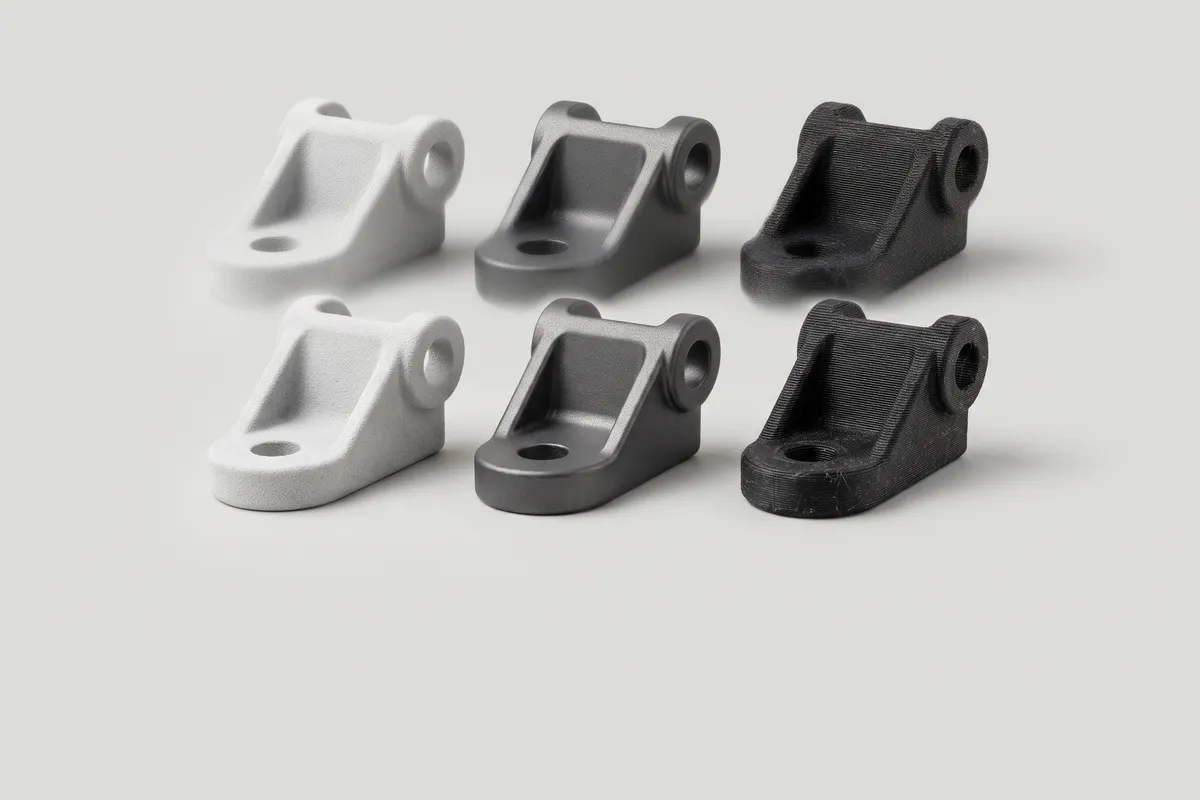
A laser fuses the powder. The large build volume of 700 × 380 × 580 mm allows large parts in one piece. The surface is matt and, according to the data sheet, slightly rougher than with MJF. Minimum supported wall 1 mm.MJF (Multi Jet Fusion)
A print head applies fusing and detailing agents, and infrared light fuses the whole layer. The parts are grey, their properties more uniform in all directions, and for larger quantities MJF is often cheaper. Minimum supported wall 0.6 mm.Smoothing the surface
For MJF parts, chemical smoothing can be ordered. The surface becomes denser and smoother, which improves cleaning and feel.Threads in PA12
For load-bearing threads, brass or Helicoil inserts are fitted in SLS and MJF parts. They can be selected directly in the online quote.
When to choose PA12-GF and when PA12-CF.
PA12-GF is a polyamide 12 with glass beads mixed in. The beads make the material roughly twice as stiff as unfilled PA12 and reduce warping, which helps with larger, flat parts. According to the data sheet, the heat deflection temperature under low load rises to 160 °C. In return, the elongation at break drops to around 5%: the material tends to break rather than give way. Like PA12, it is printed with SLS without support structures.
PA12-CF is a carbon-fibre-reinforced polyamide 12 for FDM. It is the strongest of the three materials, with 72 MPa tensile strength in the layer plane, and absorbs little moisture at about 1.5%, much less than carbon-fibre-reinforced PA6. Because it is extruded, it needs supports for overhangs, and its strength in the build direction is lower.
As a rule of thumb: unfilled PA12 for tough parts, clips, hinges and complex geometries. PA12-GF for stiff, low-warp parts exposed to heat. PA12-CF for heavily loaded brackets and fixtures with simple geometry.
PA12 for small series without tooling.
Because many parts fit into the build volume at the same time in the powder bed, PA12 is suitable not only for rapid prototyping but also for small series. How many parts fit into one build depends on their size, not on their shape. There is no injection mould, changes to the part only cost a new CAD model, and every series can look different from the previous one.
This is particularly interesting for parts that can only be injection-moulded with slides or in several pieces: undercuts, internal channels, integrated hinges or assemblies printed in one piece. MJF produces such series with uniform properties and a grey surface that can be chemically smoothed. More on the page about series production.
Design rules for PA12 parts.
The rules in the powder bed are slightly different from those for injection moulding or FDM.
Walls not too thick
Solid cross-sections are more prone to warping and use more material. Even wall thicknesses and ribs instead of solid material are better.The powder has to come out
Cavities need openings so that the unmelted powder can be removed. Closed cavities remain filled with powder.Clearance for moving parts
Joints and parts printed inside each other need a gap so that they do not sinter together. At least 0.5 mm with SLS, 0.6 mm with MJF.Living hinges and snap fits
Thanks to its high elongation at break, PA12 is suitable for snap fits and hinges that are moved many times. Thin cross-sections and large radii help.Observe the minimum dimensions
Holes from 1 mm with SLS and 0.9 mm with MJF, details from 0.4 mm. All values in the Material Finder.
Further reading.
SLS 3D printing
The process for PA12 without support structures.
MJF 3D printing
PA12 for series with uniform properties.
PA12-GF in the Material Finder
Stiff, low-warp PA12.
PA12-CF in the Material Finder
Carbon-fibre-reinforced PA12 for FDM.
Resin in 3D printing
Smooth surfaces and fine details with SLA and DLP.
Frequently asked questions.
- Polyamide 12, also called nylon 12, a tough, semi-crystalline thermoplastic with low water absorption. In 3D printing it is the standard material for SLS and MJF.
- Both are polyamide 12. MJF parts are grey, slightly smoother and more uniform in all directions, and often cheaper in series. SLS offers a larger build volume.
- The SLS PA12-GF is filled with glass beads, not glass fibres. It is stiffer and warps less than unfilled PA12; its elongation at break is lower.
- According to the data sheet, the heat deflection temperature is 145 °C under low load (HDT-B) and 82 °C under higher load (HDT-A). The melting point is 183 °C.
- For MJF, chemical smoothing can be ordered. Further surfaces and coatings are listed under post-processing.
- The price depends mainly on the volume, hardly on the complexity. After upload, the online quote shows the price for SLS and MJF directly.
Order a PA12 part.
Upload your model and compare SLS, MJF and the reinforced versions in the online quote. Price and delivery time appear immediately.
Published on 22 November 2026.
Sources: Swiss3D, technical data sheet PA12 (SLS), TDS-SLS-PA12 (German) · Swiss3D, technical data sheet PA12 (MJF), TDS-MJF-PA12 (German) · Swiss3D, technical data sheet PA12-GF (SLS), TDS-SLS-PA12-GF (German) · Swiss3D, technical data sheet PA12-CF (FDM), TDS-PA12-CF (German)
Sample images created with AI.