Additive manufacturing.
Additive manufacturing is the technical term for industrial 3D printing: a part is made directly from 3D data by building up material layer by layer, instead of cutting it from a block or shaping it in a mould. The standard ISO/ASTM 52900 distinguishes seven process categories, from material extrusion to laser melting of metal powder.
- Plastics and metals
- FDM, SLS, MJF, SLA and metal 3D printing
- From one piece, without tooling
- Price online after upload






What additive manufacturing means.
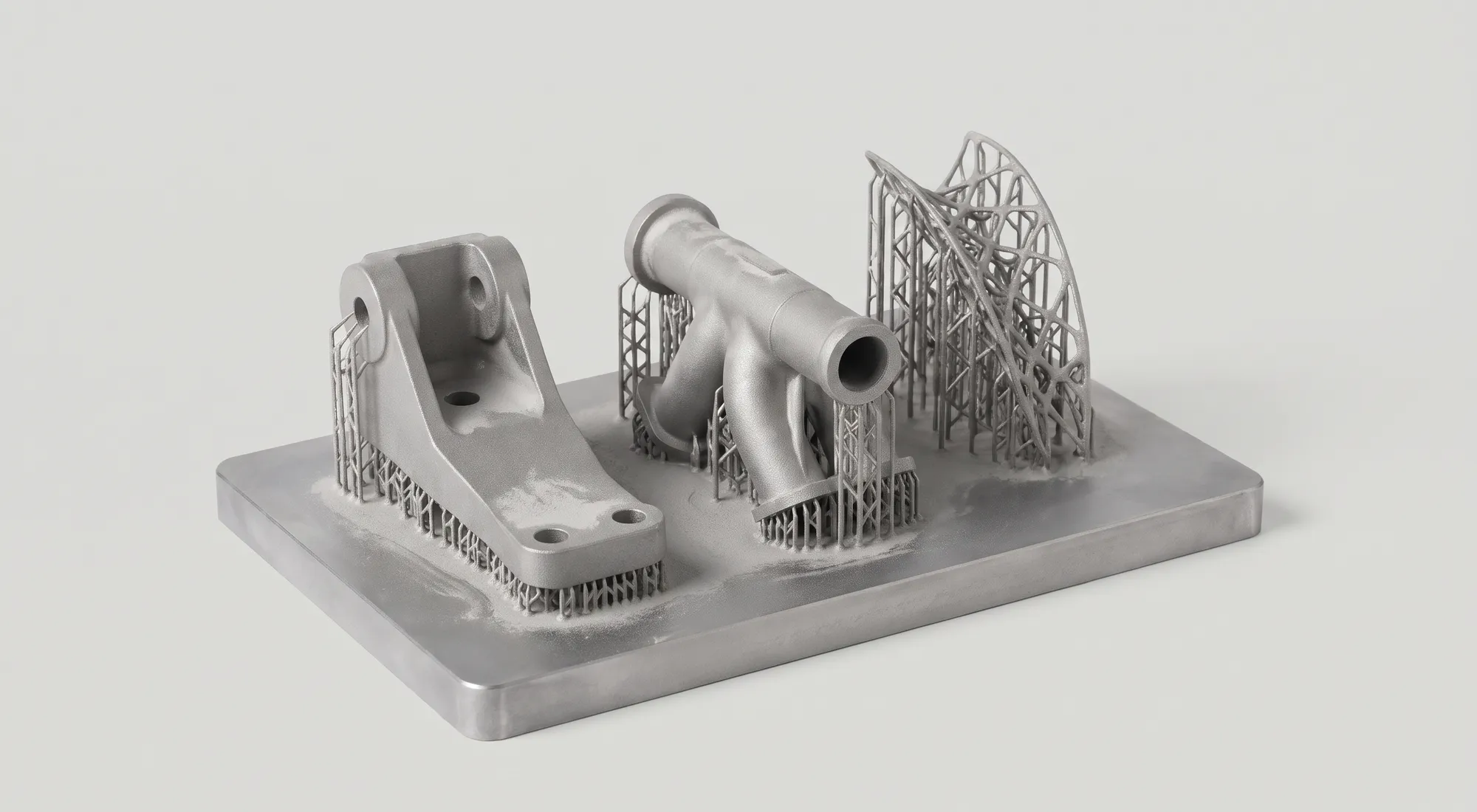
Conventional manufacturing relies on two basic principles. Subtractive processes such as milling, turning and drilling remove material from a blank until the desired shape remains. Formative processes such as injection moulding, casting and forming shape material with a mould or a tool. Additive manufacturing is the third principle: it adds material only where the part is to be, directly from the data of a 3D model.
The international standard ISO/ASTM 52900 defines the terms and describes additive manufacturing as joining materials to make parts from 3D model data, usually layer upon layer. “3D printing” is the everyday name for the same thing. The German guideline VDI 3405 groups the applications by purpose: prototypes, tools and moulds, and end-use parts. The first area is covered in the article on rapid prototyping.
Because no tooling has to be made, a single part in additive manufacturing costs hardly more per piece than the hundredth. A change only needs a new file. That shifts the comparison with conventional processes: additive manufacturing pays off especially for small quantities, many variants and geometries that would otherwise be costly or impossible to make.
The seven process categories of ISO/ASTM 52900.
The standard classifies all additive processes by the physical principle that joins the material. Many brand names belong to one of these seven categories.
| Criterion | Principle | Well-known processes | Typical materials |
|---|---|---|---|
| Material extrusion | Thermoplastic is pushed through a nozzle and deposited track by track | FDM, FFF | PLA, PETG, ASA, polyamide, PEEK, fibre-reinforced plastics |
| Powder bed fusion | Energy selectively fuses powder in a powder layer | SLS, MJF, SLM, LPBF | Polyamide, TPU, aluminium, stainless steel, titanium, nickel alloys |
| Vat photopolymerisation | Light cures liquid resin in a vat | SLA, DLP | Photopolymers, also clear or tough |
| Material jetting | Droplets of material are jetted and cured | PolyJet, material jetting | Photopolymers, multicolour |
| Binder jetting | A binder glues powder together, usually followed by sintering | Binder jetting | Sand, gypsum, metal powder |
| Directed energy deposition | Wire or powder is melted where it is deposited | DED, laser cladding, WAAM | Steel, titanium, nickel alloys |
| Sheet lamination | Foils or sheets are cut and bonded | Sheet lamination | Paper, plastic film, metal foil |
Material extrusion
- Principle
- Thermoplastic is pushed through a nozzle and deposited track by track
- Well-known processes
- FDM, FFF
- Typical materials
- PLA, PETG, ASA, polyamide, PEEK, fibre-reinforced plastics
Powder bed fusion
- Principle
- Energy selectively fuses powder in a powder layer
- Well-known processes
- SLS, MJF, SLM, LPBF
- Typical materials
- Polyamide, TPU, aluminium, stainless steel, titanium, nickel alloys
Vat photopolymerisation
- Principle
- Light cures liquid resin in a vat
- Well-known processes
- SLA, DLP
- Typical materials
- Photopolymers, also clear or tough
Material jetting
- Principle
- Droplets of material are jetted and cured
- Well-known processes
- PolyJet, material jetting
- Typical materials
- Photopolymers, multicolour
Binder jetting
- Principle
- A binder glues powder together, usually followed by sintering
- Well-known processes
- Binder jetting
- Typical materials
- Sand, gypsum, metal powder
Directed energy deposition
- Principle
- Wire or powder is melted where it is deposited
- Well-known processes
- DED, laser cladding, WAAM
- Typical materials
- Steel, titanium, nickel alloys
Sheet lamination
- Principle
- Foils or sheets are cut and bonded
- Well-known processes
- Sheet lamination
- Typical materials
- Paper, plastic film, metal foil
Terms according to ISO/ASTM 52900:2021 and VDI 3405. For functional parts in industry and product development, material extrusion, powder bed fusion and photopolymerisation are the most widely used.
Additive processes for plastics and metals.
Swiss3D offers processes from the three most important categories. Which one fits depends mainly on the material, the load and the surface.
FDM (material extrusion)
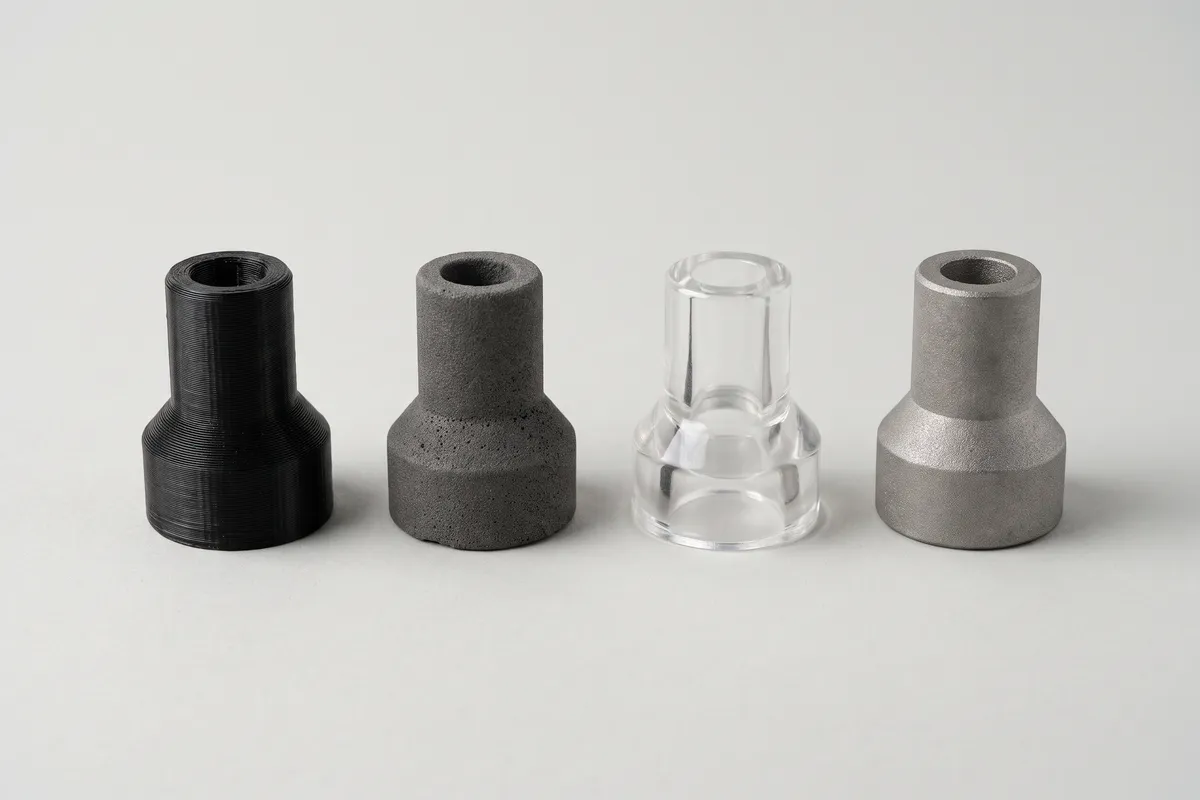
For fixtures, brackets and large samples. Twelve materials from PLA to PEEK, including carbon-fibre-reinforced polyamides. Parts up to 800 × 800 × 800 mm in PLA and PETG, delivery time usually 2–5 working days.SLS (powder bed fusion)
A laser sinters polyamide or TPU powder. No support structures, tough and similarly strong in all directions. For functional parts, snap fits and housings up to 700 × 380 × 580 mm.MJF (powder bed fusion)
Infrared lamps fuse a whole powder layer at once. PA12 in grey or black, with a fine-grained surface and designed for series of identical parts.SLA and DLP (photopolymerisation)
UV light cures resin layer by layer. Smooth surfaces and fine details, also clear. For appearance models, small precise parts and moulds.Metal 3D printing (powder bed fusion)
A laser melts metal powder completely, a process known as selective laser melting. Aluminium, stainless steel, titanium, Inconel 718 and copper for parts with internal channels, lightweight structures or complex geometry.
The process chain: from CAD model to finished part.
It starts with a closed 3D model, ideally a STEP file, because it describes the geometry exactly. STL breaks the surface down into triangles and is also sufficient for many plastic parts. During data preparation the part is oriented in the build volume, given support structures where needed and sliced into layers. The orientation affects strength, surface, dimensional accuracy and cost, especially with FDM and metal printing.
In the build process the part is created layer by layer. This is followed by process-specific steps: powder bed parts are unpacked from the powder and blasted, SLA parts are washed and post-cured, FDM and metal parts are freed from their supports. Metal parts are usually heat-treated to relieve residual stresses, and their functional surfaces are often machined.
Finally comes post-processing as required, for example blasting, painting or thread cutting. At Swiss3D the chain starts with the upload: the online quote checks the model and shows price and delivery date for the process and material before you order.
Strengths of additive manufacturing.
The advantages show above all where conventional processes are held back by tooling costs, accessibility or set-up times.
No tooling
No mould, no fixture, no set-up time. The very first part already has the production quality of the process, and a change only costs a new file.Freedom of geometry
Undercuts, internal channels, lattice structures and nested shapes are possible that no cutter can reach and no mould can release.Function integration
Several individual parts can be combined into one component, such as a housing with brackets, clips and cable routing. That saves assembly and fasteners.Variants and batch size one
Every part in the build volume can be different. Customised versions, spare parts and small batches cost hardly more per piece than standard parts.Lightweight design
Material is only built up where it carries load. Ribs, cavities and lattices reduce weight, especially in metal printing with aluminium and titanium.Short lead time
From model to part often takes only a few working days. Development loops and spare-part procurement become much shorter as a result.
Limits and what to watch out for.
Additive manufacturing does not simply replace milling and injection moulding. These points decide whether a part makes sense additively.
Direction-dependent properties
Parts built in layers are often not equally strong in every direction. The difference is greatest with FDM; powder bed processes are much more uniform. Design loaded parts with the build orientation in mind.Surface and dimensional accuracy
Printed surfaces show layers or a grainy texture. Tight fits, sealing faces and bearing seats are usually machined afterwards or produced by CNC machining in the first place.Material specification
A printed material is not the same as its cast, rolled or injection-moulded counterpart, even if it has the same name. Where standards or approvals require a specific semi-finished material, a printed part needs its own approval.Part size
Every process has a limited build volume. Larger parts are split and joined, or produced with large-format printing.Unit costs in large series
For high volumes of simple parts, injection moulding becomes cheaper per part at some point. Where the break-even lies depends on size, material and complexity. A comparison is given in the article 3D printing vs. traditional manufacturing.
When additive manufacturing pays off.
In industry and product development, additive manufacturing is firmly established in several areas. Prototypes and functional samples are the classic use. They are joined by fixtures, gauges and grippers for assembly and production lines that have to be adapted quickly, and by spare parts for machines for which there is no tooling and often no drawing any more.
End-use parts are also increasingly made additively: housings and brackets in small series, parts with integrated functions and metal parts with internal cooling or media channels. MJF and SLS are designed for small series without tooling; more on the page about series production.
The quickest way to see whether a particular part makes sense additively is a price: upload the model, choose process and material, and compare it with the quote for a milled or cast part. The main cost drivers are listed on the page about 3D printing costs.
Further reading.
Frequently asked questions.
- Essentially yes. “Additive manufacturing” is the standard technical term according to ISO/ASTM 52900, “3D printing” the common name. In industry, additive manufacturing is often used when series and end-use parts are meant.
- The standard ISO/ASTM 52900 distinguishes seven categories: material extrusion, powder bed fusion, vat photopolymerisation, material jetting, binder jetting, directed energy deposition and sheet lamination.
- Thermoplastics such as PLA, PETG, ASA, polyamide and PEEK, fibre-reinforced plastics, elastic TPU, photopolymers and metals such as aluminium, stainless steel, titanium, Inconel and copper. The Material Finder gives an overview with properties.
- For one-off parts and small series it is often cheaper than conventional processes because there are no tooling costs. For large quantities of simple parts, injection moulding is usually cheaper per part.
- That depends strongly on the process, the material and the size. Values per material are listed in the Material Finder. For tight fits, functional surfaces are machined or the part is milled.
- In many cases yes, for example housings, brackets and small series in PA12. Where standards prescribe a specific semi-finished material, a printed part needs its own approval.
Have your part made additively.
Upload your model and compare processes and materials: price and delivery date are fixed in seconds. For metal parts, large assemblies or questions about design, send us an inquiry.
Published on 22 November 2026.
Sources: ISO/ASTM 52900:2021, Additive manufacturing – General principles – Fundamentals and vocabulary · VDI 3405, Additive manufacturing processes, rapid manufacturing – Basics, definitions, processes · ISO/ASTM 52910:2018, Additive manufacturing – Design – Requirements, guidelines and recommendations · Gebhardt, Kessler, Schwarz, Thurn: Additive Fertigungsverfahren, Hanser (German) · Zäh et al., Additive Fertigungsverfahren, University of Augsburg (German)
Sample images created with AI.