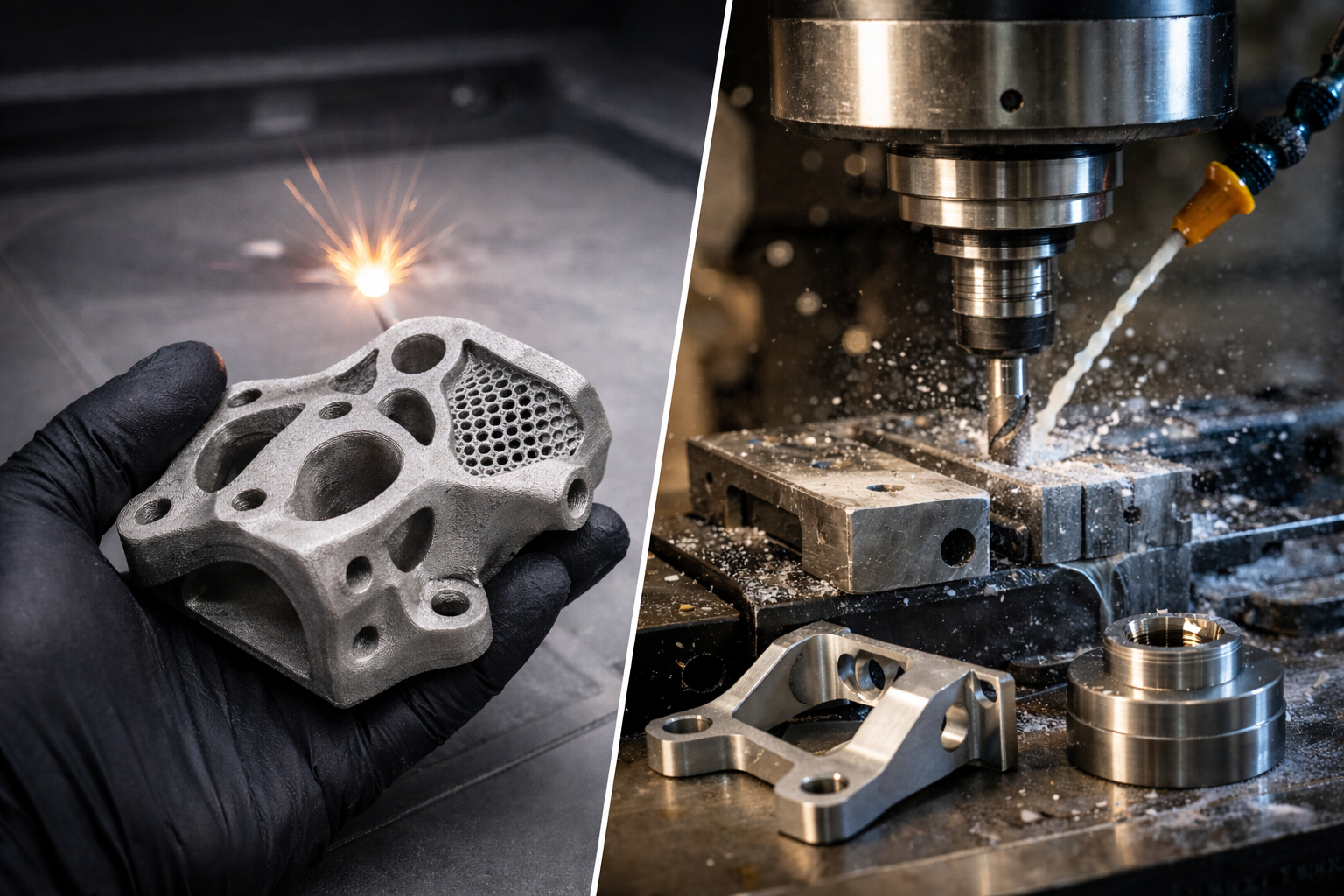
Additive vs. traditional manufacturing: When does what pay off – and why the question is often asked wrong
Anyone dealing with 3D printing for the first time usually asks the same question: "Is it actually better than traditional manufacturing?" Short answer: It depends. Long answer? You'll find it here.

Elia Dubach
Head of Consulting
There is hardly a topic in the manufacturing world that causes as much confusion as the comparison between additive and traditional manufacturing. On one side stands industry with decades of experience, huge machines, and proven processes. On the other side is 3D printing – young, media-present, and often misunderstood.
And somewhere in between sits the entrepreneur or product developer who simply wants to know: What is the best solution for my part? Spoiler: There is no universal answer. But there are clear criteria by which you can decide. And that's exactly what this article is about.
What is traditional manufacturing, actually?
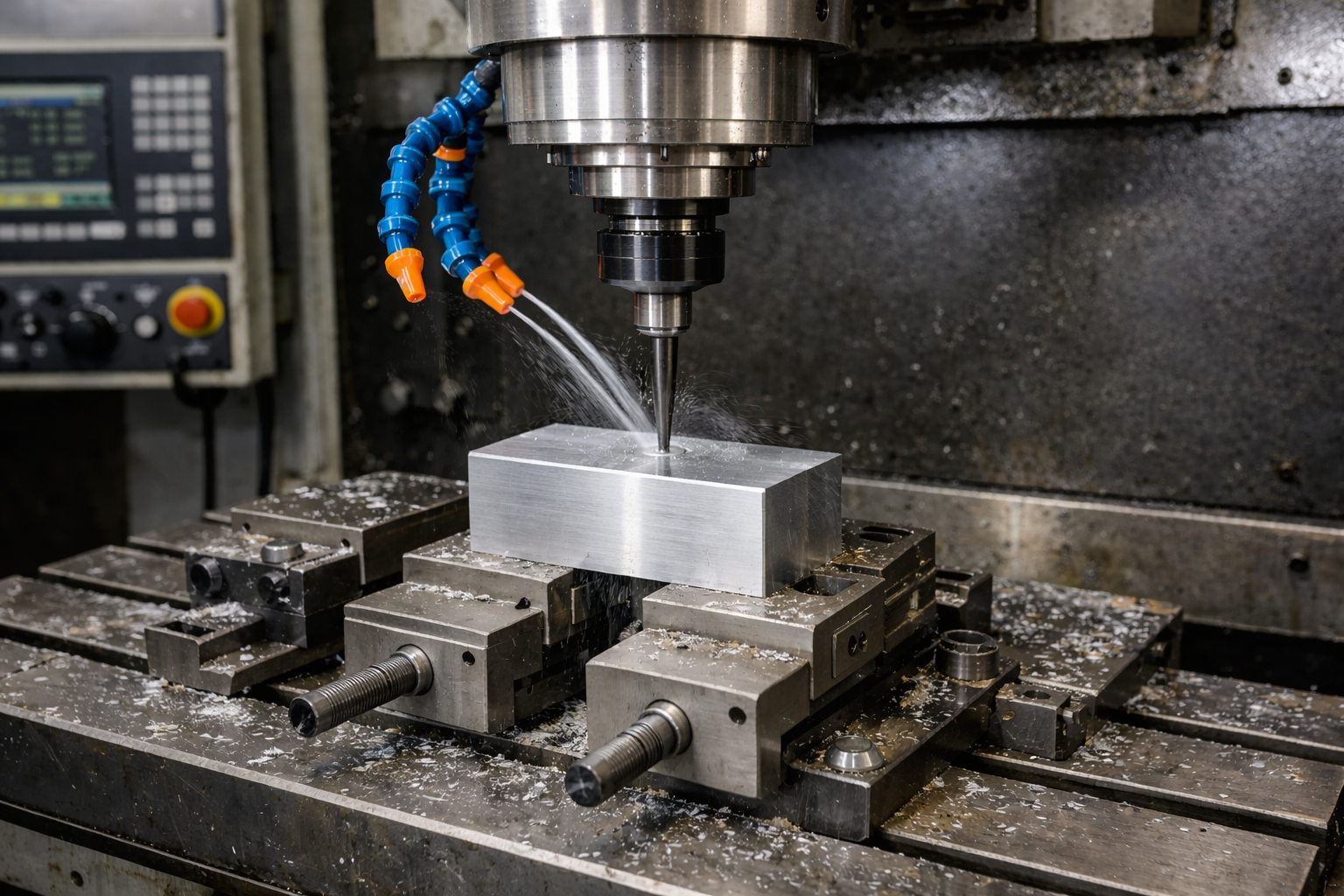
When we talk about traditional or conventional manufacturing, we mean all processes in which material is removed or reshaped to produce a component. The best-known representatives:
CNC machining (milling, turning, drilling): A block of raw material – metal, plastic, wood – is shaped into the desired form by computer-controlled tools. What doesn't belong to the end product ends up as chips in the collection container.
Injection molding: Liquid material is pressed into a mold under high pressure. Result: thousands of identical parts in a short time. The catch: The mold must first be manufactured – and that costs.
Casting and forging: Metal is heated, shaped, cooled. For massive, high-load parts, often still the first choice.
These processes have been the standard for decades for good reason. They are fast for large quantities, deliver precise results, and the process chains are well understood. Anyone who needs 50,000 identical screw covers will be much happier with injection molding than with any other method.
But – and this is a big but – they have their weak points. And these show up exactly when things get interesting.
What makes additive manufacturing different?
Additive manufacturing, commonly known as 3D printing, reverses the approach: Instead of removing material, it is built up layer by layer. The basis is always a digital 3D model – a CAD file. This is divided into thin cross-sections, and the machine builds the part from bottom to top.
Depending on the technology, this happens in different ways:
FDM (Fused Deposition Modeling): A plastic filament is heated and pushed through a nozzle – layer by layer. The "classic" among 3D printing processes.
SLA (Stereolithography): Liquid resin is cured by UV light. Extremely fine details and smooth surfaces.
SLS (Selective Laser Sintering): Powder – usually nylon – is fused point by point by a laser. No support structures needed.
SLM / DMLS (Metal): The same as SLS, but with metal powder. Titanium, stainless steel, aluminum – directly from the printer.
What all these processes have in common: They don't need tools or molds. The model is the tool. That sounds like a small thing, but it has massive consequences.
The real differences – beyond the hype
Tooling costs: The biggest lever
In traditional manufacturing, tooling costs are incurred before the first part is produced. An injection mold for a medium-complexity component? Easily 10,000 to 50,000 Swiss francs. After that, each part is cheap – but the initial investment must first be borne.
With 3D printing, there are no tooling costs. No mold making, no setup, no waiting. You send the file, we print. This is an enormous advantage, especially for small series, prototypes, or one-off pieces.
Geometric freedom: What CNC can't do
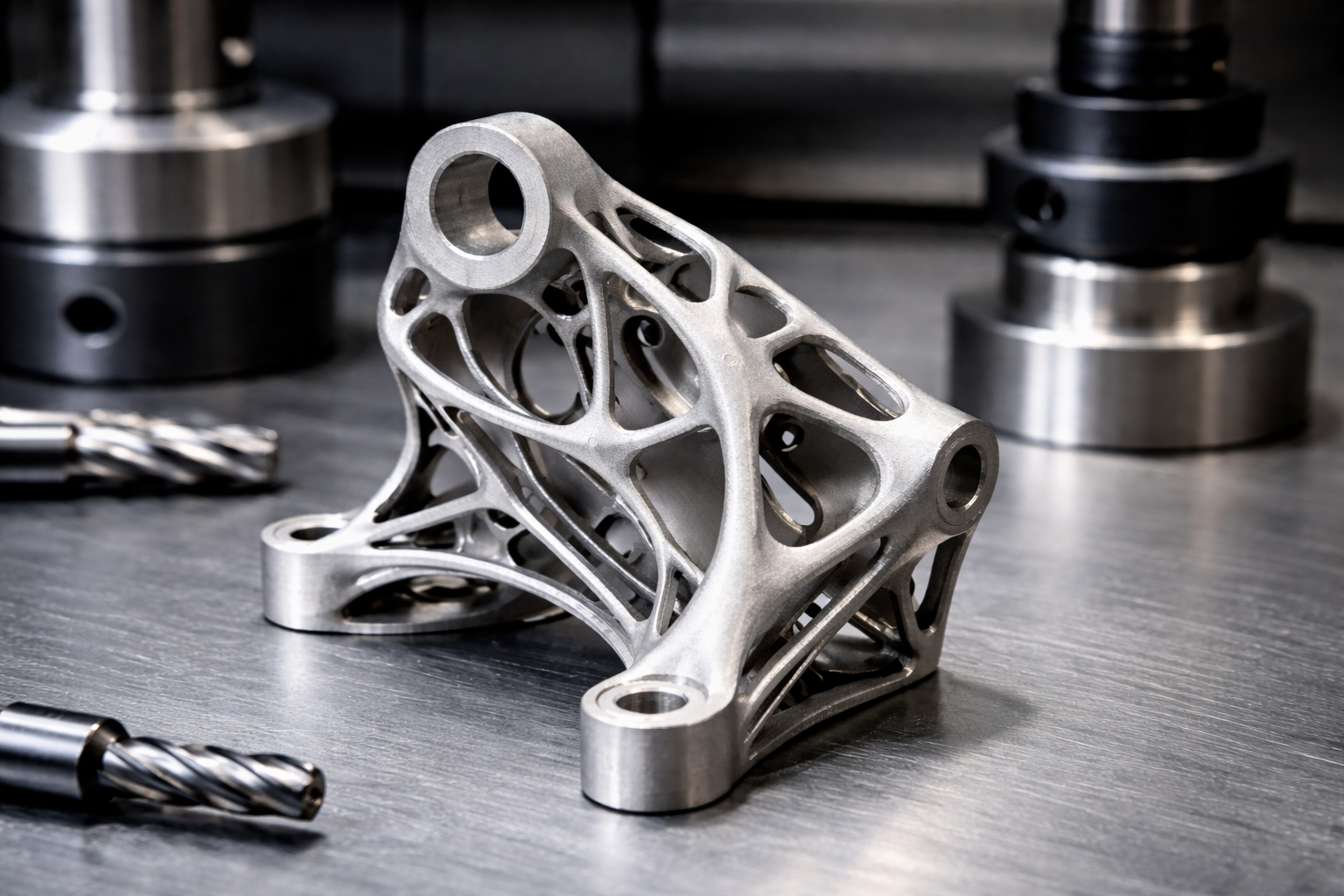
Undercuts. Internal channels. Lattice structures. Organic shapes without a straight surface. All of this is either impossible with conventional milling machines or only feasible with enormous effort.
Additive manufacturing knows hardly any limits here. If it can be modeled, it can usually be printed. This opens up possibilities in component optimization that were unthinkable just a few years ago – for example, parts that become lighter through internal honeycomb structures without losing stability.
Quantity: The decisive factor
This is the point at which most decisions should be made. As a rough rule of thumb:
1 to ~250 parts: 3D printing is almost always cheaper and faster.
250 to ~2,000 parts: Depends on complexity – often a hybrid approach makes sense.
2,000+ parts: Traditional manufacturing usually wins through decreasing unit costs.
This is of course simplified. A highly complex metal part that is hardly feasible conventionally even at 5,000 pieces remains a candidate for SLM. A simple plastic block needed ten times is sometimes faster done with CNC.
Materials: More choice than expected
A common misconception: 3D printing is only for plastic. That hasn't been true for a long time. Today, standard thermoplastics (PLA, ABS, PETG), high-performance plastics (PEEK, Nylon, TPU), resins for optically high-quality parts or dental applications, metals of all kinds (titanium, stainless steel, aluminum, Inconel), and composite materials with carbon fiber reinforcement are printed.
The selection grows every year. What traditional manufacturing has: an even broader material base and above all decades of experience with material behavior under load. For safety-critical metal parts in aerospace or medical technology, AM still runs – but with strict qualification processes.
Surfaces and tolerances
Here, traditional manufacturing still often has the advantage. A CNC-milled part can achieve tolerances in the hundredths range and simultaneously have a flawless surface. 3D-printed parts have visible layer lines (more or less depending on the process) and must be post-processed.
At Swiss3D, surface treatment is standard – every part is sandblasted and further refined as required. What comes from our operation is not a raw print object, but a fully finished component.
When to use what?
Here's a direct decision guide without sugarcoating:
Choose 3D printing if...
You need one-off pieces or small series, your design is complex or frequently modified, you need a functional prototype quickly, the part has geometries that are conventionally impossible or difficult to produce, or you want to avoid tooling costs.
Choose traditional manufacturing if...
You produce large quantities of a consistent part, the highest surface quality or tight tolerances without post-processing are required, you work with materials that are not yet mature in 3D printing, or unit costs are the priority in the long term.
Consider a hybrid approach if...
You develop with 3D printing and then produce with conventional processes, you need tools, fixtures, or holders for your production line, or parts are printed and then machined.
A practical example
A mechanical engineering company needs a new bracket for a production line. Three variants are under discussion, the design is not yet final. Quantity now: 5 parts for testing, later perhaps 200.
Traditional manufacturing: CNC milling possible, but expensive for 5 pieces. Every design change costs setup time and money. Injection molding is out of the question at this quantity due to tooling costs.
3D printing: Adapt the file, print tomorrow, test the day after. Next version? Three clicks in CAD, same procedure. When the design is final and 200 parts are ordered, you can still decide: continue printing or switch to conventional manufacturing.
This is exactly what 3D printing is made for.
What does this mean for you as a customer?
When you come to Swiss3D, we bring experience with FDM, SLA, SLS, and metal printing processes. We look at your component, your requirements, your quantities – and honestly recommend the process that makes the most sense for your case. Sometimes that's 3D printing. Sometimes the answer is: You're better off going to the CNC service provider around the corner.
But when 3D printing is the right choice, we do it right.
Häufige Fragen
Wann ist 3D-Druck günstiger als konventionelle Fertigung?
Bei Stückzahlen unter 250 Einheiten ist 3D-Druck fast immer wirtschaftlicher, da keine Werkzeug- oder Formenkosten anfallen. Auch bei häufig wechselnden Designs oder komplexen Geometrien punktet die Additive Fertigung klar gegenüber Spritzguss oder CNC.
Welche Toleranzen erreicht der 3D-Druck im Vergleich zu CNC?
Je nach Verfahren liegen die Toleranzen zwischen ±0,1 mm (SLA) und ±0,3 mm (FDM). CNC-Fräsen erreicht ±0,01 mm und weniger. Für hochpräzise Passungen bleibt konventionelle Fertigung oft im Vorteil – für funktionale Prototypen und Kleinserien reicht 3D-Druck-Präzision in den meisten Fällen aus.
Kann Swiss3D auch Metallteile im 3D-Druck herstellen?
Ja. Mit SLM (Selektives Laserschmelzen) fertigt Swiss3D Metallteile aus Titan, Edelstahl, Aluminium und Inconel – direkt ohne Werkzeuge oder Formen. Besonders geeignet für komplexe Metallbauteile in Kleinserien, die mit CNC kaum oder nur sehr teuer herstellbar wären.
Wie lange dauert ein 3D-Druckauftrag bei Swiss3D?
Einzelteile und kleine Serien werden in der Regel innerhalb von 2–5 Werktagen geliefert. Für dringende Anfragen steht ein Express-Service zur Verfügung. Die genaue Lieferzeit hängt vom Verfahren, Material und der Teilegeometrie ab.
Brauche ich ein eigenes CAD-Modell, um bei Swiss3D zu bestellen?
Idealerweise ja – eine STL- oder STEP-Datei ist die Grundlage jedes Druckauftrags. Falls Sie kein fertiges Modell haben, hilft das Konzept-Design-Team von Swiss3D, Ihre Idee in ein druckfertiges 3D-Modell umzusetzen.
Conclusion
Additive and traditional manufacturing are not competitors – they are tools. And like any tool, one has its strengths, the other its weaknesses. Those who know the differences make better decisions: faster, cheaper, with fewer surprises along the way.
Do you have a project where you're not sure which process is right? Then send us the CAD file or briefly describe what you need. We'll take a look – uncomplicated and without obligation.