3D Printing in Mechanical Engineering
Functional prototypes, spare parts, and production aids
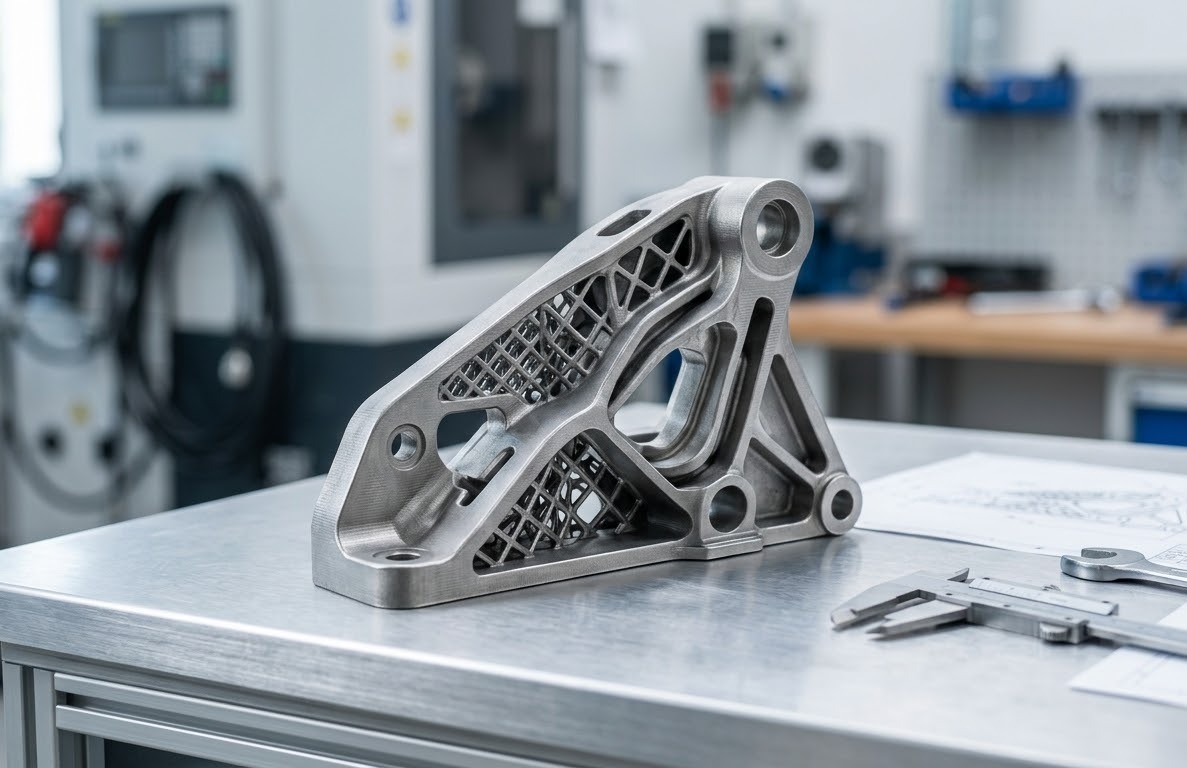
From concept models to load-bearing functional parts to small series: Swiss3D supports mechanical engineers with fast additive manufacturing. Engineering plastics and metals, tolerances down to ±0.1 mm, post-processing included — no tooling costs.
Overview
Rapid iteration and functional parts for mechanical engineering
In mechanical engineering, prototypes must be mechanically robust, spare parts quickly available, and production aids flexibly adaptable. Additive manufacturing shortens development cycles, eliminates tooling costs, and enables geometries impossible to mill or cast. Swiss3D manufactures with engineering thermoplastics (PA12, PA11, TPU), metals (aluminum, stainless steel, titanium), and offers CNC post-processing, threading, and surface finishing. From single parts to small series — with consistent quality control.
Applications
Application areas
Typical parts and use cases that we manufacture.
Functional prototypes
Load-bearing parts for mechanical testing, assembly trials, and customer approvals — in production-grade materials.
Spare parts on demand
No longer available components as single pieces or small series — via reverse engineering and 3D scanning.
Production aids & fixtures
Clamping fixtures, gauges, and assembly brackets for manufacturing — quickly adapted, individually designed.
Housings & covers
Protective housings, covers, and control elements from impact-resistant ABS or glass-fiber-reinforced nylon.
Gears & drive parts
Gears, pulleys, and couplings from wear-resistant PA12 or metal — for testing or small series.
Hydraulics & pneumatics
Valve housings, manifolds, and adapters from aluminum or stainless steel — sealed and pressure-resistant.
Grippers & handling
Robot grippers, suction cups, and end-of-arm tools — adapted to part geometry and cycle time.
Special machine components
Individual parts for special systems — from linear guides to complex assemblies.
Advantages
What you can expect from Swiss3D
Fast delivery from 1 day
Express production from 24h, standard parts in 2–5 business days — for agile development cycles and short-term approvals.
25+ materials
Engineering thermoplastics, high-performance nylons, elastomers, resins, plus aluminum, stainless steel, and titanium for every requirement.
Free expert consulting
Our engineers check your design for printability, suggest material alternatives, and optimize tolerances — at no extra charge.
Transparent pricing
Instant quote directly in the configurator, no hidden costs. Every item transparently calculated and documented.
Manufacturing processes
Available printing processes
Each process has specific strengths — we're happy to advise you on the selection.
Cost-effective prototypes and functional parts from engineering thermoplastics like ABS, ASA, or PETG.
View materials
Production-grade parts from PA12 nylon with high mechanical strength — without support structures.
View materials
Isotropic strength and fine details for functional small series and end parts from PA12.
View materials
Highest surface quality and detail accuracy for visual prototypes and precision parts.
View materials
Fully dense metal parts from aluminum, stainless steel, or titanium for maximum loads.
View materials
Highest detail accuracy and surface quality for visual prototypes and precision parts.
View materialsFrequently asked questions
Häufige Fragen zu 3D-Druck im Maschinenbau